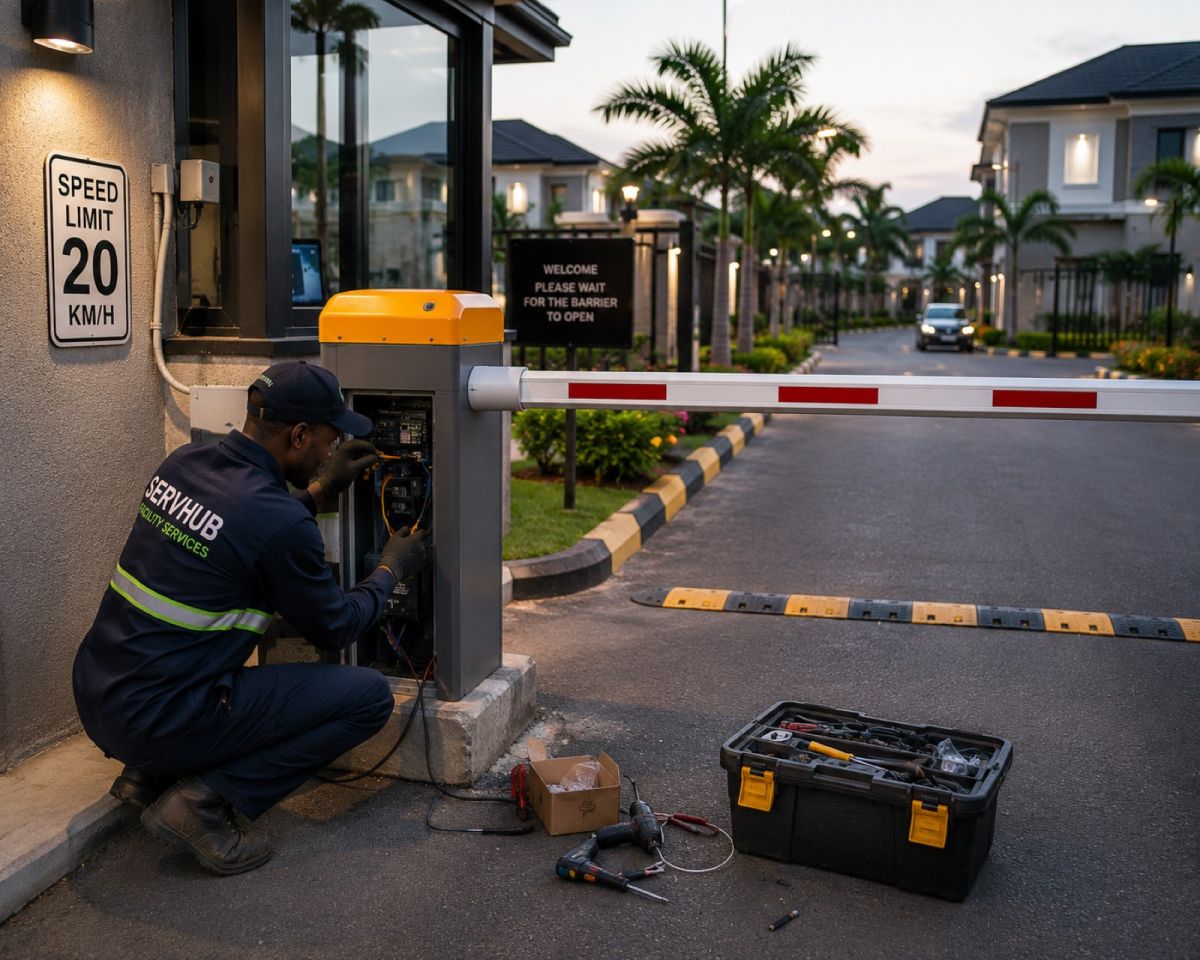
A boom barrier for estate gates in Nigeria should do one thing reliably: control vehicle movement without turning the entrance into a daily problem. The wrong unit can create queues, fail during outages, damage vehicles or remain permanently raised because the estate has lost confidence in it.
For an estate, the barrier arm is only one part of the system. Traffic volume, arm length, duty cycle, safety sensors, backup power, access control and installation quality all matter. This guide explains what an estate committee, developer or facility manager should check before paying a supplier.
What should you check before buying a boom barrier?
Start with the gate, not the brand.
Measure the vehicle lane and estimate how many cars pass through it during the busiest hour. A quiet entrance at midday may behave very differently between 5 p.m. and 8 p.m. when residents are returning home.
Before requesting a final quotation, establish the lane width, expected daily traffic, peak-hour traffic, available power, how residents will be recognised, how visitors will be cleared and what happens if the internet goes down.
If the estate is planning a wider security upgrade, first understand how an access control system in Nigeria fits together. The boom barrier is the physical arm; the access-control process decides when that arm should open.
A site visit also matters. A proper access-control site survey should examine the road layout, drainage, cable routes, guardhouse position, pedestrian movement, power source and where the barrier base can safely be installed.
Arm length, opening speed and duty cycle
Arm length should match the actual lane. Do not estimate it by eye.
An arm that is too short leaves unnecessary space beside it, while an unnecessarily long arm can require a different mechanism and slower operation.
Manufacturer specifications show why estates should compare models carefully.
CAME currently lists automatic barriers with passage widths ranging from about 3.8 metres to 12 metres. Opening speeds also vary considerably, from around 1–2 seconds on some high-speed models to about 10 seconds on its long-arm GARD 12.
FAAC's current B614 specification provides another example: it supports a beam up to 6 metres, can open in under two seconds with a 3-metre beam and is designed for continuous use.
These specifications show why a supplier should not simply tell an estate that a barrier is “strong.”
Ask for:
- the exact model;
- maximum arm length;
- opening and closing time;
- use frequency or duty rating;
- motor type;
- protection rating;
- and recommended traffic level.
A small residential estate with moderate traffic and a large estate with hundreds of evening vehicle movements do not need the same equipment.
Safety, vehicle detection and gate control
A boom arm should not close simply because a timer has expired.
The installation should account for vehicles or people still beneath the arm. Depending on the equipment, this may involve photocells, loop detectors, obstacle detection or other safety devices.
FAAC's current B614 documentation, for example, describes integrated motor control with reverse-on-obstacle capability as part of its safety design.
Ask the installer to demonstrate the safety system with an actual vehicle before the estate accepts the installation.
The next question is who tells the barrier to open.
Some estates start with a gateman operating the barrier manually. Others connect it to card readers, number-plate systems, keypads or vehicle access control for estates.
RFID can also reduce repetitive gate interaction for resident vehicles. If you are considering that approach, understand how RFID vehicle stickers for estates work before deciding whether long-range recognition makes sense for your entrance.
Automation should support the gate procedure, not replace clear security rules.
Power and internet failures must be planned for
An automatic estate gate that becomes unusable whenever public power fails is not practical.
Ask the supplier how much power the barrier, controller and readers consume and exactly what will keep them operating during an outage.
Depending on the estate, this may involve:
- battery backup;
- inverter power;
- a generator;
- solar and batteries;
- or a combination of these.
Read our guide to backup power for gate hardware before deciding how the system should be powered.
Backup capacity should be based on expected traffic and outage duration rather than simply adding the smallest available battery to the quotation.
Also test complete power failure.
There should be a manual-release procedure, and gatemen on every shift should know how to use it. The manual-release key should also be stored somewhere accessible to authorised gate staff.
Internet failure is a different problem.
The barrier motor itself does not inherently require an internet connection to move. However, a cloud-dependent access-control system may need connectivity before it can approve a resident, visitor or vehicle credential.
Ask the installer what happens when the router is unplugged.
If approved credentials can be checked locally and synchronised later, ask for that capability to be demonstrated during commissioning rather than accepting it verbally.
What should a complete quotation include?
Do not compare two boom-barrier suppliers using only the final total.
Ask for an itemised quotation.
It should clearly show:
Barrier unit. Brand, model, arm length and motor.
Controller. The equipment responsible for operating the barrier.
Access equipment. RFID readers, long-range readers, keypads, remotes or other credentials where required.
Safety devices. Photocells, loop detectors or other vehicle-detection equipment.
Civil work. Foundation, concrete base, road cutting and reinstatement where required.
Cabling and conduit. Power and communication cables together with their installation.
Backup power. Batteries, inverter, solar equipment or another specified arrangement.
Installation and commissioning. Configuration and proper testing of the completed system.
Training. Gatemen and administrators should know how normal and emergency operation works.
Warranty. Ask what is covered, for how long and whether labour is included.
Replacement parts. Find out how quickly common damaged or failed components can be obtained.
This makes competing quotations easier to understand and exposes where an apparently cheap offer has removed important equipment.
Installation quality also matters.
The concrete base must be able to handle repeated movement of the weighted arm. Cables should be protected, electrical equipment should not sit where water collects, and sensors should be correctly positioned.
Before accepting the installation, test repeated opening and closing, vehicle detection, manual release, backup power and the complete access-control workflow.
Boom barrier or sliding gate?
They solve different problems.
A boom barrier is designed primarily for frequent vehicle control.
A sliding gate provides a more complete physical closure of an entrance.
Many estates can reasonably use both.
The boom barrier can manage normal vehicle movement during busy periods while the main gate provides stronger physical closure when required.
Our detailed comparison of boom barriers vs sliding gates for estates explains where each system works best.
The right choice depends on traffic volume, security objectives, entrance design, available space and how the estate operates its gate at different times of day.
Maintenance and how Kompound fits in
Budget for maintenance when the barrier is purchased rather than waiting for the first breakdown.
Routine checks should include:
- mounting bolts;
- arm condition;
- balancing components;
- photocells;
- loop detection;
- electrical connections;
- batteries;
- access readers;
- and the manual-release mechanism.
Follow the manufacturer's service requirements for the particular model installed.
Also ask whether common replacement parts are available locally and how quickly a damaged arm, sensor or control board can be replaced.
Kompound approaches estate access from the decision at the gate, rather than treating the boom barrier as the entire security system.
A resident can create a visitor pass before a guest arrives. At the gate, the visitor can be checked through the estate's access workflow instead of depending entirely on phone calls, handwritten visitor books or scattered WhatsApp messages.
That means an estate can start with digital visitor management and introduce barriers, vehicle readers and other access hardware as its requirements grow.
The boom barrier for estate gates in Nigeria should therefore be the final physical step in a properly designed access process, not the entire security system by itself.
The goal is straightforward: authorised vehicles move through efficiently, visitors are checked properly, outages do not cripple the entrance and the estate maintains a usable record of what happened at the gate.