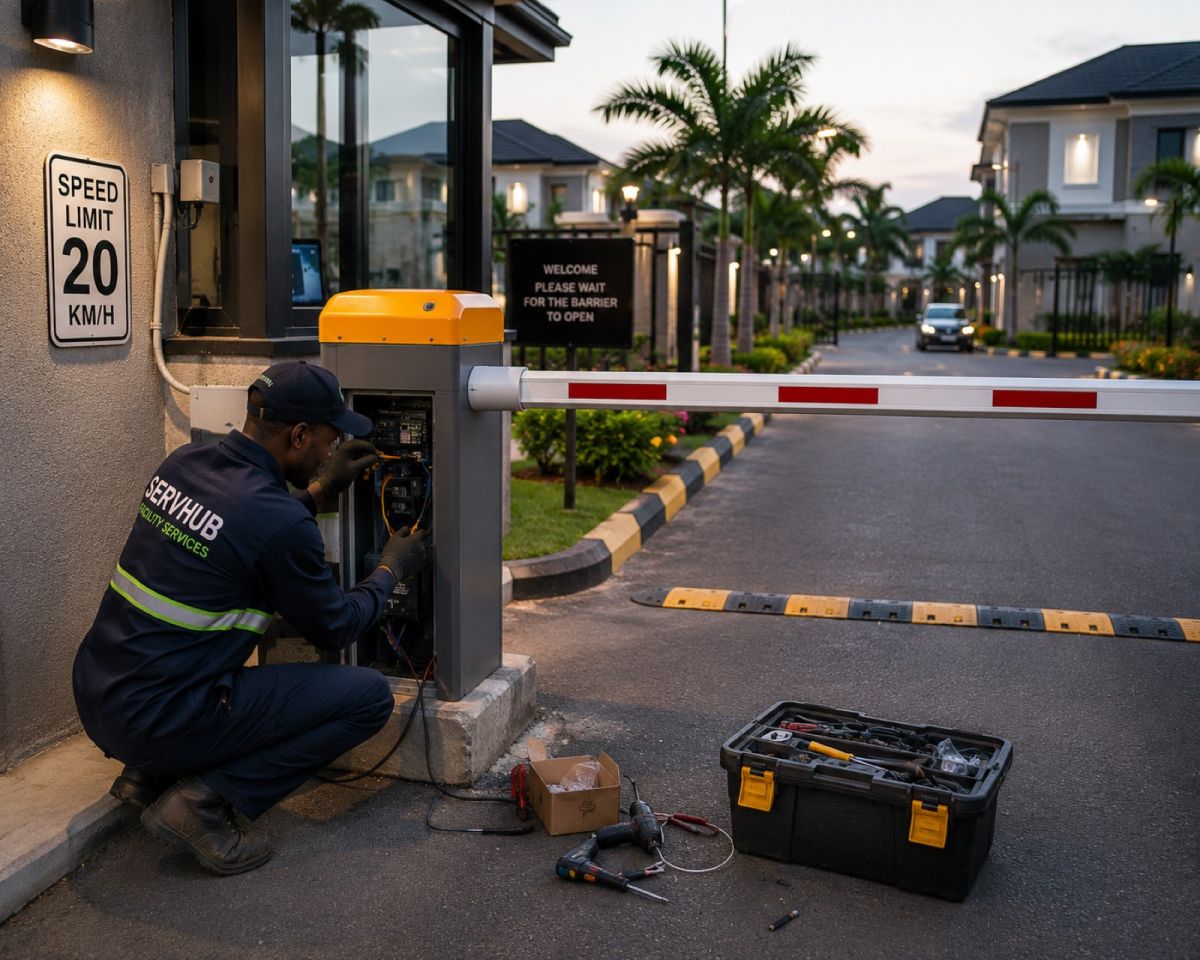
A boom barrier is the most visible thing an estate buys. It is also the item most often bought badly, because committees compare quotations on the only number they understand, which is the total, and quotations in this market are not comparable on the total.
This guide is about what is actually inside the price, and what to check before money changes hands.
Why we do not publish a naira figure
You came here looking for a price, so let us deal with that honestly.
Barrier hardware is imported. The landed cost moves with the exchange rate, with shipping, with duty and with which brand a supplier happens to be holding. A figure published today will be wrong within months, and a guide that quotes one is either out of date or making it up.
What does not change is the structure of the price. If you understand that, you can read three quotations that look nothing alike and tell which one is serious. That is worth more than a number.
What a complete quotation contains
Insist that every quotation is itemised under these headings. A supplier who will not itemise is quoting you a lump sum and hoping you do not ask.
The barrier unit itself. Brand, model, arm length, motor type and opening time.
The controller. What takes the decision to open, and where it takes it.
Credentials and readers. Card readers, long range readers, keypads, or nothing if the gateman operates it manually.
Safety devices. Photocells or a loop detector, so the arm does not come down on a car or a child.
Civil work. The concrete base, the island or plinth, and any cutting or reinstating of the road surface.
Cabling and conduit. Power to the barrier, signal to the controller, and the trenching to lay both.
Power and backup. How the barrier keeps working through an outage.
Commissioning and training. Somebody setting it up properly and showing your gate team how to use it.
Warranty and spares. What is covered, for how long, and how quickly a replacement arm arrives.
The last four are where cheap quotations hide. A barrier at a very attractive price with no safety device, no backup power and no spares is not cheaper. It is a deposit on a problem.
The specifications that actually matter
Arm length. Measure your carriageway, do not estimate it. An arm that is too short leaves a gap somebody will drive through. An arm that is too long is slower and puts more strain on the motor. Folding and articulated arms exist for entrances with low overhead obstructions.
Opening time. Usually quoted in seconds for a 90 degree movement. Faster is not automatically better, because speed comes from a more aggressive motor which wears faster, but a slow barrier on a busy evening gate creates exactly the queue you were trying to remove.
Duty cycle. This is the specification most committees never ask about and the one that decides whether your barrier survives. It describes how many operations per hour the unit is built for. A barrier rated for light use, installed on a four hundred house estate, will fail, and it will fail during the evening rush.
Motor type. Electromechanical units are simpler, cheaper and easier to service locally. Hydraulic units handle higher duty cycles and longer arms, cost more, and need somebody competent when they leak. For most Nigerian estates, a well specified electromechanical unit with the right duty cycle is the sensible choice.
Manual release. There must be a way to raise the arm by hand when everything else has failed. Check it works before you sign off, and make sure every shift knows where the key is.
Ingress rating. The cabinet will stand outside through rainy season, dust and sun. Ask for the IP rating and look at the cabinet material.
Power is where estates get caught
A barrier that cannot open during an outage is a barrier that turns your gate into a wall.
Ask two questions. How much current does the unit draw when operating, and what backup is included? A barrier, a controller and a reader running on a properly sized battery should keep operating for hours, not minutes. Solar is a realistic option at a gate, but it has to be sized for the actual duty cycle rather than fitted as a token panel.
Equally important is what happens to the arm when power fails entirely. Some units drop. Some hold. Know which yours does before you find out.
The controller decides more than the barrier does
The barrier is a motor and an arm. The controller is what decides whether to open, and that decision is where your estate's security actually lives.
The question to ask is: where is the decision taken? If the controller has to reach a server to check whether a code is valid, then every time your line drops, your gate falls back to guesswork. The approved list and valid codes should sit on the controller at the gate, with the record syncing when the connection returns.
Test this during the demonstration. Ask the supplier to unplug the router. Thirty seconds, and it tells you more than the rest of the specification sheet.
Also ask whether the controller will talk to your estate software, and what happens when it does not. A barrier with its own isolated software leaves you running two systems and reconciling two records by hand.
Installation, in the order it should happen
A proper installer does a site survey before quoting. They measure the carriageway, look at where power is coming from, check the ground for the base, work out cable routes, and look at how traffic actually moves at your gate in the evening rather than at eleven in the morning.
Findings from that survey change the price. An installer who quotes without visiting is guessing, and the difference will appear later as a variation.
During installation, the base matters more than it looks. A barrier is a machine that slams a weighted arm up and down thousands of times, and a base that was not cured properly will loosen. Get the base right, get the conduit in before the road is reinstated, and do not let anybody run signal cable in the same conduit as power without proper separation.
Maintenance, which nobody budgets for
Barriers are mechanical. They need servicing, and the estates that do not budget for it are the estates whose barrier is permanently up within two years, which is the same as not having one.
Plan for periodic greasing, checking and tightening mounting bolts, photocell alignment and cleaning, battery testing and replacement on a cycle, and arm replacement after the inevitable collision. Hold a spare arm on site. They are the most commonly damaged part and the one that stops the gate entirely.
Ask the supplier for a service schedule and a price for it at the point of purchase, not afterwards.
How this fits with Kompound
The barrier is the last part of a chain, not the start of one. It only helps if the decision reaching it is correct, and that decision is made by whoever issued the visitor pass.
With Kompound, your resident issues a six digit pass and sends it to their guest. At the gate that code is checked against a list held locally on the gate device and the controller, so the check still happens when the network is down. Entry and exit write to the same record as your dues, your notices and your faults.
That is also why we tell estates not to start with hardware. A gateman and a phone will change your gate experience immediately. The barrier, the readers and the cameras come when the estate is ready, on the same system, without starting again.
FAQ
How long should a boom barrier last?
A correctly specified and maintained unit should give you many years of service. A unit specified below its actual duty cycle will not, regardless of brand.
Can we install it ourselves and save money?
The unit can be mounted by any competent team. The base, the cabling, the safety devices and the commissioning are where self installation costs more than it saves.
What happens if a car hits the arm?
On a well designed unit the arm is the sacrificial part and is replaceable. Keep a spare on site.
Do we need a reader, or can the gateman operate it?
Manual operation is a perfectly legitimate starting point, and many estates run this way for a long time. The record still needs to exist regardless of who presses the button.
Should we buy the barrier and the software from the same supplier?
Not necessarily, but make somebody accountable for them working together. Two suppliers each blaming the other is a common and expensive outcome.