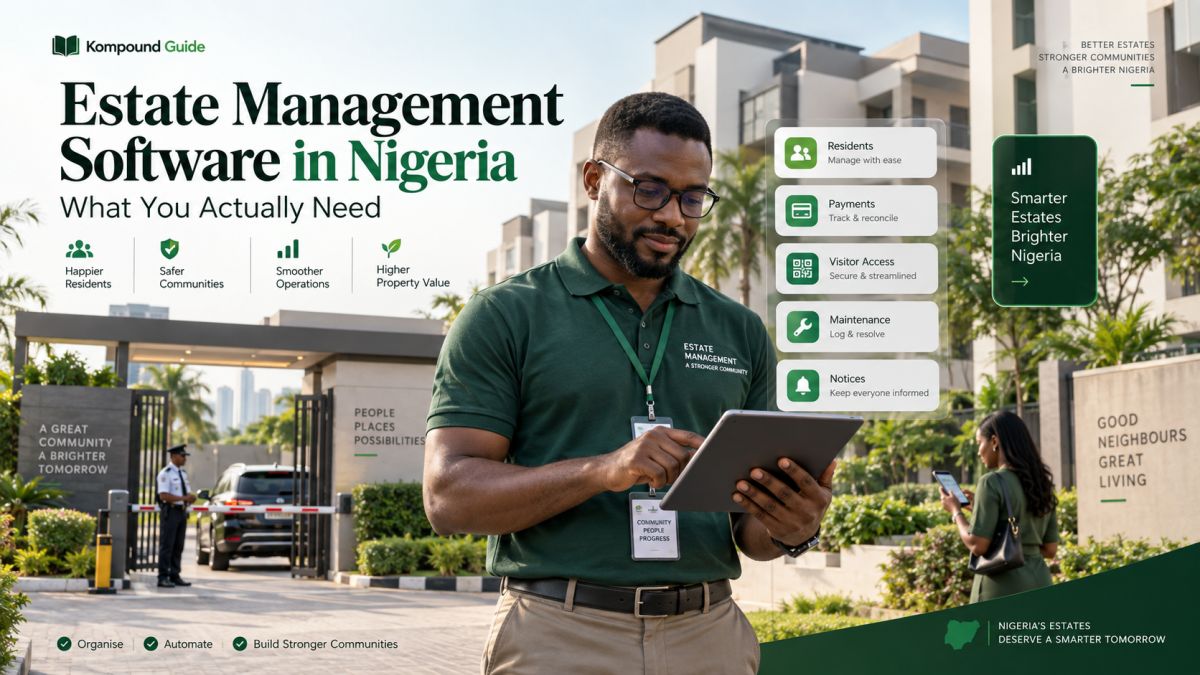
If you manage a residential estate in Nigeria, you probably do not need more WhatsApp groups, more spreadsheets or another notebook at the gate.
You need one reliable place where you can see what is happening across your estate.
Your residents.
Your dues.
Your visitors.
Your security team.
Your complaints.
Your notices.
Your maintenance issues.
Your payment records.
That is what good estate management software in Nigeria should help you control.
The software should not make your estate more complicated.
It should remove the repetitive work that currently depends on phone calls, paper records and one EXCO member remembering everything.
What is estate management software?
Estate management software is a digital system that helps you manage the daily operations of a residential estate or gated community.
Instead of keeping separate records in different places, you bring important estate activities into one platform.
Depending on the system you choose, you may be able to manage:
- Residents and properties
- Estate dues and levies
- Visitor access
- Security and gate operations
- Complaints and maintenance issues
- Estate announcements
- Payment records
- Staff and contractors
- Emergency alerts
- Access-control hardware
- Reports and administration
The important question is not:
> “How many features does the software have?”
The better question is:
> “Will this solve the problems you deal with every week?”
You probably already have an estate management system
It may just be spread across five different tools.
You may currently use:
WhatsApp for announcements and complaints.
Excel for dues and resident records.
Bank transfers for payments.
A visitor notebook at the gate.
Phone calls for visitor approval.
Paper receipts for some transactions.
Individual EXCO members to remember unresolved problems.
Each tool may work on its own.
The problem appears when you need them to work together.
A resident pays an estate levy.
The treasurer sees the bank credit.
The resident sends a screenshot.
Someone updates a spreadsheet later.
Another EXCO member has an older copy.
Three months later, there is an argument about the person's balance.
That is not really a payment problem.
It is a record-management problem.
Good estate software should reduce those gaps.
What should estate management software actually do for you?
You do not need every technology available.
You need software that handles the work your estate already has to do.
1. Keep your resident and property records organised
You should be able to see who lives where without searching through WhatsApp messages.
Your system should help you organise things such as:
- Property or unit
- Owner
- Tenant
- Occupants
- Contact details
- Registered vehicles
- Account status
- Move-in or move-out information
- Relevant emergency contacts
When someone moves out, you update the record.
When a new tenant moves in, you create the new record.
When your EXCO changes, the information should remain with the estate.
That continuity matters.
Your estate records should not disappear because the former secretary changed phones.
2. Help you collect and track estate dues
This is one of the biggest reasons estates start looking for management software.
Your estate may collect:
- Annual dues
- Monthly service charges
- Security levies
- Waste fees
- Generator contributions
- Special project levies
- Other agreed charges
The difficult part is often not creating the charge.
The difficult part is knowing:
Who has paid?
Who still owes?
Who made a part payment?
Which payment belongs to which property?
How much does the estate still expect to collect?
Good software should make those answers easier to find.
You should not have to compare a bank statement against hundreds of payment screenshots every time you prepare a report.
3. Give your residents a better way to manage visitors
Your visitor-management process is part of your estate-management system.
If every visitor requires security to call the resident, you are creating unnecessary work for residents and guards.
A better system allows your resident to approve the visitor before arrival.
The process can become:
You approve your visitor → the visitor receives a temporary credential → security verifies it → entry is recorded.
That is faster and easier to audit.
Your estate software should also help you handle other people entering the estate, including:
- Dispatch riders
- Artisans
- Contractors
- Domestic workers
- Event guests
- Drivers
- Regular visitors
Read next: Visitor Management for Nigerian Estates.
4. Give your security team a clear process
Your gatemen should not need to guess.
When someone arrives, security should be able to determine quickly whether the person has been approved.
Your system should help answer:
- Who is the visitor?
- Who invited them?
- Is the pass valid?
- Has it expired?
- When did the visitor enter?
- Did the visitor leave?
- Which guard processed the visit?
If your estate uses compatible hardware, the same system may also connect with things such as:
- Boom barriers
- QR readers
- Keypads
- RFID systems
- Pedestrian access
- Vehicle access control
The software and the physical gate should support the same process.
5. Let residents report problems properly
Someone notices that the streetlight outside House 22 is not working.
What happens next?
In many estates, the resident posts:
> “Please, this streetlight has been bad for days.”
Someone replies.
Another person tags the chairman.
The conversation moves on.
Two weeks later, somebody asks again.
Your estate management software should turn that complaint into something you can actually track.
For example:
Streetlight fault → assigned to maintenance → technician attends → issue resolved → resident notified.
You should know which problems are:
- New
- Assigned
- In progress
- Waiting for action
- Resolved
That is much more useful than trying to manage maintenance through chat history.
6. Separate official notices from everyday conversations
Your estate WhatsApp group may be useful.
You do not necessarily need to remove it.
But you should not depend on it for every important announcement.
Official information can disappear between:
> “Good morning neighbours.”
> “Who owns this car?”
> “Please, who has a plumber?”
and fifty other messages.
Your estate software should give you a place for notices residents may actually need to find again.
That can include:
- Meeting notices
- Planned maintenance
- Water interruptions
- Security alerts
- New estate rules
- Payment reminders
- Event announcements
- Emergency communication
WhatsApp can remain the conversation.
Your estate platform becomes the record.
7. Help you understand what is actually happening
Software becomes more valuable when it helps you answer questions.
For example:
- How many residents have paid this year's dues?
- How much is still outstanding?
- Which issues remain unresolved?
- How many visitors entered this week?
- Which properties have overdue charges?
- What payments came in this month?
- What happened at the gate yesterday?
- Which estate notices were sent?
You should not need three people and an afternoon of spreadsheet work every time the EXCO wants a basic report.
What good estate management software looks like
When you compare systems, do not be distracted by long feature lists.
Look for a few important things.
It should be easy for your residents
If residents cannot understand the app, adoption will be poor.
Your residents should be able to complete common tasks without needing a training manual.
Creating a visitor pass should feel simple.
Checking a bill should feel simple.
Reporting a problem should feel simple.
If ordinary actions require too many steps, people will go back to WhatsApp.
It should be easy for your gatemen
This matters even more.
Your gate interface may be used:
- At night
- In bright sunlight
- During rain
- While several vehicles are waiting
- By security personnel with different levels of technical experience
The system should give your guard a clear answer quickly.
Approved.
Expired.
Invalid.
Already used.
Security software should reduce uncertainty.
It should work with Nigerian operating conditions
Ask what happens when:
- The internet goes down
- Electricity goes off
- A resident changes phones
- The EXCO changes
- A security officer changes shift
- A payment cannot immediately be identified
- Your estate grows from 50 homes to 500
Do not evaluate software only when everything is working perfectly.
Evaluate what happens when something fails.
Your records should not belong to one individual
The system should preserve continuity.
If your treasurer leaves office, the estate should still have its financial records.
If the chairman relocates, your resident records should remain.
If you replace your facility manager, your maintenance history should still exist.
The information belongs to the estate.
Before you buy estate software, fix your process
Software cannot rescue a process that nobody understands.
Before implementation, decide basic things such as:
- Who can create charges?
- Who approves expenses?
- Who can invite visitors?
- Who can view resident information?
- Who reviews complaints?
- Who manages security accounts?
- Who sends official notices?
- Who closes resolved issues?
- Who controls administrative access?
Then configure the software around those responsibilities.
Do not buy software and expect the software company to invent your entire estate policy.
The best implementation combines:
clear estate rules + simple processes + appropriate technology.
What does estate management software cost in Nigeria?
There is no single price that applies to every estate.
Your cost may depend on:
- Number of residents
- Number of properties
- Features required
- Number of gates
- Payment functionality
- Access-control hardware
- Installation
- Training
- Support
- Custom integrations
A 40-unit estate that mainly needs visitor management and dues tracking does not necessarily need the same setup as a 1,000-unit development with several entrances and automated access control.
When asking for pricing, give the provider enough information to understand how your estate operates.
Ask:
What is included?
What costs extra?
Is setup included?
Is training included?
Does the estate pay or do residents pay?
Are payment charges separate?
What happens when we add more residents?
What does hardware cost?
You should understand the full operating cost before committing.
Read next: Estate Software Pricing Models Explained.
Do you need hardware too?
Not always.
You can use estate software without automating your physical gate.
Your gateman may simply use a phone or tablet to verify visitors.
Later, if your estate wants more automation, you can consider hardware such as:
- Boom barriers
- Keypad terminals
- QR readers
- RFID readers
- Vehicle tags
- Access controllers
- Number-plate recognition
Do not start with expensive hardware simply because it looks impressive.
Start with the problem.
Then decide which technology solves it.
Common mistakes you should avoid
Buying because another estate uses it
Your estate may have different problems.
Understand your own requirements first.
Choosing the longest feature list
More features do not automatically mean better software.
You need the features people will actually use.
Ignoring the gatemen
Your resident app may look excellent, but if security cannot use the gate system properly, one of the most important parts of the platform has failed.
Ignoring residents during rollout
If residents do not understand why the system exists, some will resist it.
Explain what improves for them.
Replacing every process at once
You may get better adoption by introducing the most important workflows first.
For example:
Residents → visitors → dues → issues → additional features.
Depending completely on internet access
Ask what still works when connectivity disappears.
Leaving old records scattered everywhere
Migration matters.
Decide which resident records, balances and important historical information need to move into the new system.
Treating software as the solution to poor governance
Technology helps you enforce good processes.
It does not replace them.
How Kompound helps you manage your estate
Kompound is designed around the work you already have to do in a Nigerian residential estate.
Instead of separating residents, security, visitors, dues and estate issues into unrelated tools, you can manage them through one connected platform.
With Kompound, your estate can bring together areas such as:
Residents and units
Keep your resident and property information organised in one place.
Visitor management
Your residents can create visitor passes while your security team verifies access at the gate.
Estate dues
Create charges, maintain resident balances and keep clearer payment records.
Issues and maintenance
Let residents report estate problems and give management a way to follow them through resolution.
Notices
Send important information through a dedicated estate communication channel.
Gate operations
Give your security officers a structured verification process instead of relying entirely on phone calls and handwritten visitor books.
Offline gate verification
Your gate process should not immediately collapse because connectivity becomes unreliable.
Kompound is designed so supported gate operations can continue during network interruptions and synchronise when connectivity returns.
Access-control integration
Where your estate requires additional automation, Kompound can form part of a wider setup involving compatible gate hardware.
The goal is not to add technology for the sake of technology.
It is to help you run a more organised estate.
See how Kompound would work in your estate
If you currently manage your residents, dues, visitors, complaints and gate operations across WhatsApp, spreadsheets and paper records, you do not have to replace everything blindly.
Show us how your estate currently works.
We can walk you through how Kompound would fit into your existing process, which features you actually need and what you can improve first.
There is no need to guess from screenshots.
Frequently asked questions
What is the best estate management software in Nigeria?
The right software depends on how your estate operates.
Before choosing, compare visitor management, dues collection, resident records, gate operations, maintenance tracking, data access, offline capability, ease of use, support and pricing.
Read: What to Look For in Estate Management Software.
Can you use estate software in a small estate?
Yes.
A small estate may benefit from software even if it has only a few dozen homes, particularly if you are already struggling with visitor calls, payment records or resident communication.
You do not need to wait until administration becomes chaotic.
Do residents need an app?
It depends on the platform.
A resident app can make activities such as visitor approval, payment tracking, issue reporting and estate communication easier.
Read: Residents App: What Residents Actually Use It For.
Can your gateman use estate management software?
Yes.
A good system should provide a simple interface for security personnel so they can verify visitors and perform gate-related tasks without needing access to sensitive administrative functions.
Can estate software work without internet?
Some functions can, depending on the way the platform is built.
If uninterrupted gate access matters to your estate, specifically ask what the system can do during a network outage rather than assuming every feature requires a live internet connection.
Can estate software collect service charges?
Yes.
Depending on the platform, you may be able to create estate charges, track payments, maintain resident balances and produce clearer financial records.
Can estate management software connect to a boom barrier?
Yes, where the software and access-control hardware are compatible.
This can allow an approved access event to become part of the same workflow that operates the physical gate.
Is WhatsApp enough to manage an estate?
WhatsApp is useful for communication.
It becomes difficult when you try to use it as your resident database, visitor record, accounting system, complaint tracker and official archive at the same time.
You do not necessarily need to stop using WhatsApp.
You need to stop expecting it to do jobs it was never designed to do.
The simple test
Before choosing estate management software, ask yourself:
Will this reduce the amount of chasing, calling, searching, reconciling and guessing your team does every day?
If the answer is yes, the technology is probably solving a real problem.
If it simply gives you another dashboard to manage, keep looking.
Your estate does not need more software.
You need a simpler way to run the estate.