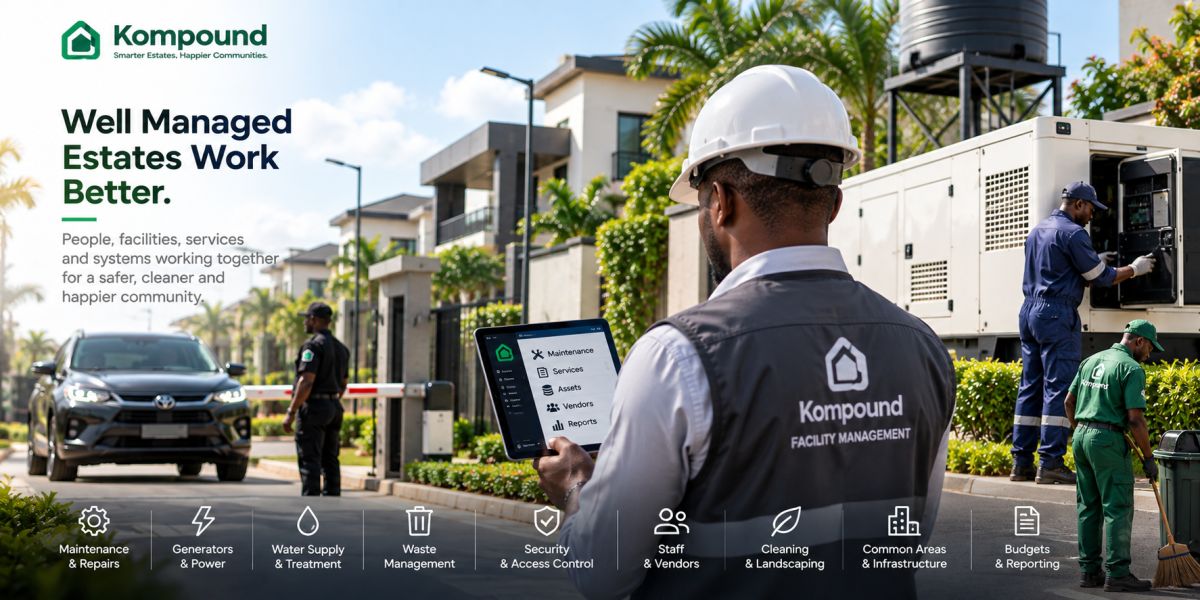
# Facility Management in Nigeria: A Practical Overview
Facility management is what keeps your property working after construction is finished.
It is the reason your gate opens, your borehole works, your generator gets serviced, your waste is collected, your security team knows what to do and small maintenance problems are fixed before they become expensive emergencies.
If you manage a residential estate in Nigeria, facility management usually means coordinating people, buildings, equipment, utilities, contractors, money and daily operations so residents can use the property safely and comfortably.
Good facility management is not simply fixing things when they break.
It is making sure fewer things break unexpectedly in the first place.
What is facility management?
The International Facility Management Association describes facility management as the function that brings together people, place and process to improve how the built environment works for the people using it.
For a Nigerian residential estate, that can cover:
- Building maintenance
- Estate roads
- Drainage
- Water supply
- Generators
- Electricity systems
- Streetlights
- Waste management
- Cleaning
- Security
- Gates and access control
- Landscaping
- Fire-safety equipment
- Contractors
- Estate staff
- Maintenance records
- Service schedules
- Budgets and operating costs
You are essentially responsible for keeping the physical community functioning.
Facility management is different from estate administration
The two overlap, but they are not exactly the same.
Your estate administration may deal with:
- Residents
- Dues
- Meetings
- Rules
- Notices
- Elections
- Complaints
Facility management focuses more heavily on the physical operation of the property.
That includes:
- Equipment
- Infrastructure
- Maintenance
- Contractors
- Utilities
- Service delivery
In a smaller estate, the same EXCO or estate manager may handle both.
In a larger estate, you may have a dedicated facility manager or external facility-management company.
What good facility management should achieve
Your residents do not normally notice good facility management.
They notice bad facility management immediately.
They notice when:
- The gate stops working
- Water disappears
- The generator fails
- Waste is not collected
- Streetlights remain broken
- Drainage blocks
- Security equipment stops working
- Repairs take weeks
- Nobody knows which contractor is responsible
A well-managed estate should feel predictable.
You should know what equipment you have.
You should know its condition.
You should know when it needs maintenance.
You should know who maintains it.
And you should know roughly what keeping it operational will cost.
Start with an asset register
You cannot manage equipment you have not properly recorded.
Your estate should maintain an asset register.
That may include:
- Generators
- Boreholes
- Pumps
- Water-treatment equipment
- Tanks
- Transformers
- Streetlights
- CCTV cameras
- Boom barriers
- Gate motors
- Access-control equipment
- Fire extinguishers
- Cleaning equipment
- Office equipment
- Recreational equipment
For each important asset, record information such as:
- What it is
- Where it is located
- Brand and model
- Installation date
- Warranty
- Service provider
- Last maintenance date
- Next maintenance date
- Condition
- Important repair history
Do not wait for a breakdown before trying to identify the equipment.
Preventive maintenance should come before emergency repairs
A common facility-management mistake is waiting for something to fail.
The generator begins making an unusual sound.
Nobody acts.
The gate motor becomes slower.
Nobody investigates.
A pump starts switching unusually.
Everyone keeps using it.
Then the equipment fails completely.
Emergency repairs are often more expensive and more disruptive than planned maintenance.
Your maintenance calendar should tell you what needs attention before failure.
Build a maintenance schedule
Your schedule does not need to be complicated.
Start with your critical assets.
Daily or frequent checks
Depending on your estate, this may include:
- Gate equipment
- Security systems
- Water supply
- Generator status
- Common-area lighting
- Cleaning
- Waste areas
Monthly checks
You may review:
- Pumps
- Gate motors
- CCTV
- Fire equipment
- Electrical panels
- Drainage
- Backup power
Quarterly or scheduled servicing
This may include:
- Generators
- Water-treatment systems
- Access-control equipment
- Pest control
- Fire systems
The manufacturer's service instructions and your actual usage should determine the correct frequency.
Do not copy another estate's maintenance interval blindly.
Your generator needs proper management
Generators remain a major facility-management responsibility for many Nigerian properties.
You should track more than diesel purchases.
Your records should include:
- Running hours
- Service dates
- Oil changes
- Filter changes
- Repairs
- Diesel consumption
- Fault history
- Contractor
- Parts replaced
If fuel consumption suddenly rises, you should be able to notice it.
If your generator is being serviced twice as often as expected, you should understand why.
Without records, unusual costs simply become normal expenses.
Water management deserves the same attention
Your water system may include:
- Borehole
- Submersible pump
- Treatment plant
- Storage tanks
- Booster pumps
- Distribution pipes
- Meters
A failure anywhere in that chain can affect the entire estate.
Your facility manager should understand:
- Daily demand
- Pump condition
- Tank levels
- Treatment schedule
- Water quality
- Leakage
- Electricity consumption
- Repair history
Water problems are easier to manage when you understand the complete system rather than responding to individual complaints.
Do not ignore drainage
Drainage is easy to forget during dry weather.
Then the rains arrive.
Your estate should inspect drains before the heavy rainy period rather than waiting for flooding.
Check for:
- Blockages
- Sediment
- Broken covers
- Poor slopes
- Illegal discharge
- Vegetation
- Damaged channels
Drainage maintenance should be planned.
It should not begin when water is already inside somebody's property.
Cleaning should have a standard
Telling cleaners to keep the estate clean is not a measurable instruction.
Define what needs to be cleaned.
For example:
- Gatehouse
- Estate office
- Roads
- Walkways
- Drainage surroundings
- Waste areas
- Clubhouse
- Staircases
- Shared toilets
- Recreational spaces
Then decide:
- Frequency
- Responsible person
- Supplies
- Inspection process
Your residents should not be the people discovering every missed task.
Waste management needs a routine
Your facility-management plan should clearly define:
- Collection days
- Collection points
- Waste contractor
- Resident responsibilities
- Overflow procedure
- Bulky waste
- Construction waste
- Cleaning around bins
Poor waste handling quickly affects sanitation, appearance and resident satisfaction.
It can also create avoidable disputes.
Security is part of facility management
Your facility manager may not directly command your security team, but your security systems are part of the property operation.
That can include:
- Gate
- Boom barrier
- CCTV
- Electric fence
- Intercom
- Access-control readers
- Security lighting
- Alarm systems
- Guardhouse equipment
Someone needs to know:
- Whether they are working
- When they were serviced
- Who repairs them
- What happens when they fail
Buying security equipment is not enough.
You have to maintain it.
Keep spare parts and critical backups in mind
Not every spare part needs to sit in your store.
But you should identify equipment where one small component can shut down an essential service.
For example:
- Pump controls
- Gate remotes
- Fuses
- Access cards
- Generator filters
- Critical cables
- Lighting components
If a part commonly fails and takes weeks to source, keeping one spare may save your estate significant disruption.
Manage your contractors properly
Facility management often depends on outside vendors.
You may use:
- Electricians
- Plumbers
- Generator technicians
- Waste contractors
- Security companies
- Cleaning contractors
- CCTV technicians
- Gate technicians
- Landscapers
- Pest-control providers
Do not manage those relationships entirely through personal phone contacts.
Keep proper vendor records.
Know:
- Company or technician
- Service provided
- Contact details
- Pricing
- Warranty
- Contract period
- Previous jobs
- Performance history
If your facility manager leaves tomorrow, your estate should still know who maintains the borehole.
Get quotations for significant work
For larger repairs or purchases, compare options.
Price matters.
But price should not be the only factor.
Consider:
- Scope
- Equipment quality
- Warranty
- Experience
- Response time
- Availability of parts
- Previous performance
- After-sales support
A cheap repair that fails again next month is not necessarily cheaper.
Define service levels
If you outsource important services, define what you expect.
For example, a maintenance contractor agreement might specify:
- Response time
- Preventive maintenance frequency
- Emergency response
- Reporting
- Parts approval
- Escalation procedure
That gives you something objective to measure.
Otherwise, every disagreement becomes a debate about what the contractor was supposed to do.
Track issues from report to resolution
Residents should have a clear way to report problems.
Once an issue is reported, you need to know:
- What happened
- Where it happened
- When it was reported
- Priority
- Person responsible
- Current status
- What was done
- When it was closed
That creates accountability.
A maintenance issue should not disappear because the WhatsApp conversation moved on.
Prioritise properly
Not every problem has the same urgency.
A broken clubhouse chair and a failed water pump should not enter the same queue.
You can classify issues as:
Emergency
Immediate risk to safety, security or essential services.
Urgent
Significant operational problem requiring quick action.
Routine
Important but not immediately disruptive.
Planned
Work that can be scheduled.
Clear priorities help you use contractors and money more effectively.
Budget for maintenance before things fail
Your annual facility budget should account for predictable costs.
Depending on your estate, that may include:
- Security
- Cleaning
- Waste collection
- Generator servicing
- Diesel
- Water systems
- Electricity
- Gate maintenance
- CCTV maintenance
- Landscaping
- Pest control
- Fire equipment
- Routine repairs
- Contractor retainers
- Emergency reserve
Your budget should also consider future replacement.
A generator, pump or barrier will not last forever.
Build a reserve for major replacement
Routine maintenance and major capital replacement are different expenses.
Replacing:
- Generator
- Transformer
- Water-treatment plant
- Estate road
- Gate system
can cost far more than your normal monthly maintenance budget.
A sinking fund or planned capital reserve can help your estate prepare gradually instead of imposing a sudden emergency levy.
Measure your performance
Facility management improves when you measure the right things.
You do not need dozens of KPIs.
Start with useful ones.
For example:
- Number of open issues
- Average resolution time
- Preventive maintenance completed on time
- Equipment downtime
- Repeat failures
- Utility consumption
- Maintenance spending
- Contractor response time
- Resident complaints
- Safety incidents
The objective is not to create dashboards for their own sake.
Use numbers that tell you where the estate is improving or deteriorating.
Watch for repeated failures
One repair is maintenance.
The same repair every two weeks is a pattern.
If the borehole pump repeatedly fails, do not keep treating each incident as unrelated.
Investigate the root cause.
It could be:
- Poor equipment
- Bad installation
- Voltage problems
- Wrong sizing
- Poor maintenance
- Operator error
Facility management should gradually reduce recurring problems.
Document every major intervention
When significant work is done, keep the record.
Record:
- Problem
- Contractor
- Date
- Cost
- Parts used
- Warranty
- Photos where useful
- Follow-up requirement
This history becomes extremely valuable later.
When equipment fails again, you know what happened before.
Facility management should survive staff changes
If your facility manager resigns, your maintenance knowledge should not leave with them.
You need organised records for:
- Assets
- Vendors
- Contracts
- Maintenance
- Pending issues
- Warranties
- Budgets
- Service schedules
- Access credentials
A good handover should make continuity possible.
In-house facility manager or outsourced company?
Both models can work.
In-house management
You employ your own facility manager and possibly maintenance staff.
This can give you:
- Direct control
- Daily presence
- Familiarity with the estate
But you must manage recruitment, training and supervision.
Outsourced facility management
You contract a specialist company.
This may provide:
- Broader technical expertise
- Established vendor network
- Structured systems
- Additional staff capacity
But you need a clear contract and performance expectations.
Hybrid
Many estates use a combination.
You may have an estate manager internally while outsourcing specialist maintenance.
Choose based on your property size, complexity and budget.
Professional standards matter
Facility management is an established professional discipline, not simply a more formal name for maintenance.
ISO 41001 sets requirements for facility-management systems designed to support effective, efficient and sustainable delivery of FM services. The current published edition is ISO 41001:2018, while ISO is developing a second edition in 2026.
Nigeria also has an official IFMA chapter supporting facility-management professionals locally.
For larger estates and commercial properties, working with trained professionals and structured standards becomes increasingly valuable.
Common facility-management mistakes
Waiting for equipment to break
Use preventive maintenance.
Keeping no asset register
Know what you own and what condition it is in.
Managing vendors through personal relationships only
Keep proper vendor records.
Choosing every contractor by lowest price
Consider quality and lifecycle cost.
Ignoring small faults
Small faults often become larger repairs.
Having no maintenance history
Document important work.
Mixing every complaint into WhatsApp
Use a trackable issue process.
Ignoring utility data
Sudden changes in diesel, water or electricity use can reveal problems.
Failing to budget for replacement
Major equipment will eventually reach the end of its life.
Depending on one facility manager's memory
The estate should retain the knowledge.
How Kompound supports facility management
Kompound can help connect residents, estate management and service operations in one system.
Instead of managing maintenance requests only through calls and WhatsApp, your estate can organise issues more clearly.
Depending on your setup, Kompound can support areas such as:
- Resident issue reporting
- Maintenance requests
- Estate notices
- Residents and units
- Vendor and service workflows
- Gate operations
- Security activity
- Estate dues
- Management records
Residents can report an issue.
Management can see that the issue exists.
The work can be followed through resolution.
That gives your facility-management team a clearer operational record.
Kompound also connects with ServHub's broader service ecosystem, which can support access to technicians and service providers for household and property needs.
Want to organise facility management in your estate?
If your maintenance is currently spread across WhatsApp messages, personal phone calls, spreadsheets and contractor notebooks, you can improve the process without changing everything at once.
Show us how your estate currently handles maintenance, residents, gate operations and service requests.
We can demonstrate how Kompound can bring those workflows together and help your management team keep a clearer record of what needs attention.
Frequently asked questions
What is facility management?
Facility management is the coordination of people, places and processes required to keep buildings and supporting infrastructure functional, safe, comfortable and efficient.
What does a facility manager do in an estate?
Your facility manager may coordinate maintenance, utilities, contractors, cleaning, waste, equipment, security infrastructure and other operational services.
Is facility management the same as property management?
Not exactly.
Property management often focuses more on ownership, tenancy, rent and commercial property administration.
Facility management focuses more heavily on the operation and performance of the physical property and its services.
What are the main types of facility maintenance?
You will commonly deal with preventive, corrective, emergency and planned maintenance.
The goal is to use preventive and planned maintenance wherever practical instead of depending entirely on emergency repairs.
Does a small estate need a facility manager?
Not always as a dedicated employee.
A small estate can assign facility-management responsibilities to an estate manager or EXCO member while using qualified contractors for specialist work.
As the property becomes larger or more technically complex, dedicated FM expertise becomes more valuable.
What records should your facility manager keep?
At minimum, keep records for important assets, maintenance, vendors, warranties, service schedules, repairs, costs and unresolved issues.
What is ISO 41001?
ISO 41001 is the international management-system standard for facility management. The current published version is ISO 41001:2018, although ISO is developing a replacement edition.
Can facility-management software help residential estates?
Yes.
Software can help you maintain resident records, track maintenance issues, organise service requests, communicate with residents and maintain operational history.
The simple principle
Good facility management means fewer surprises.
You know what equipment you have.
You know what condition it is in.
You know when it needs attention.
You know who is responsible.
And when something goes wrong, you know what happens next.
That is how you move from constantly reacting to problems to actually managing your estate.