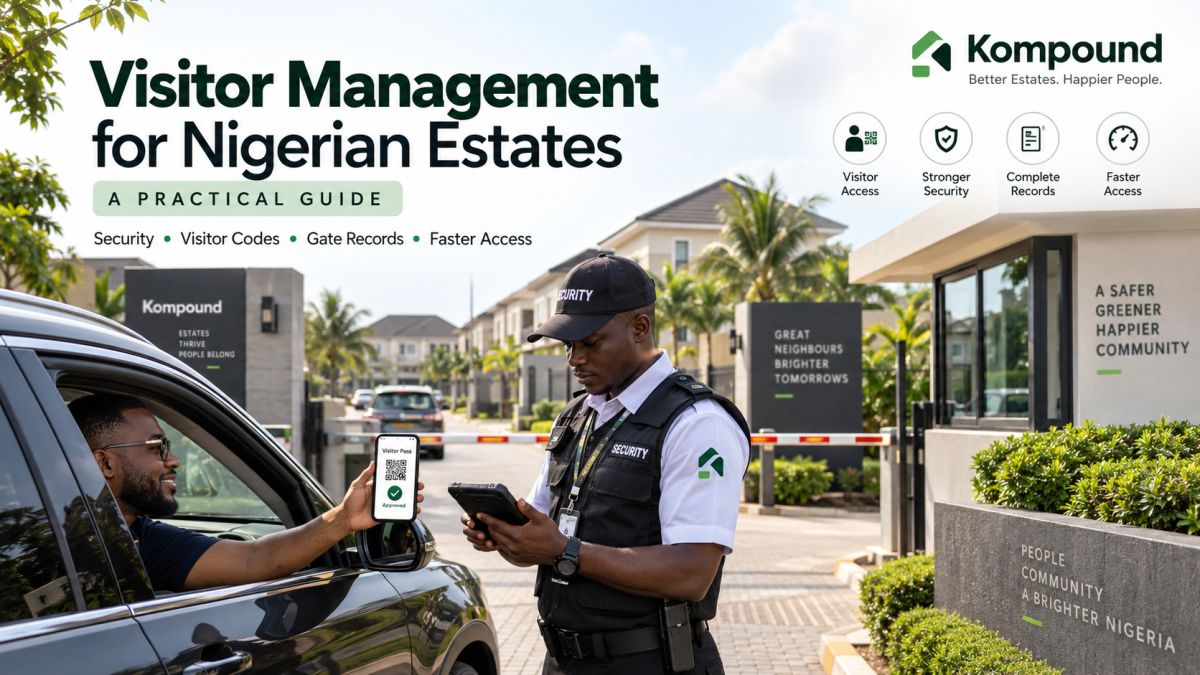
If a visitor reaches your estate gate and security needs three phone calls before deciding whether to let them in, the problem is not necessarily the gateman.
The visitor-management process is broken.
Good visitor management should answer four questions quickly:
- Who is this person?
- Who are they visiting?
- Were they approved?
- When did they enter and leave?
For Nigerian estates, the system should answer those questions without creating unnecessary queues at the gate.
It should also have a sensible plan for something Nigerian estates cannot ignore: internet and power failure.
Here is how to get it right.
What is visitor management?
Visitor management is the process an estate uses to approve, verify, admit, record and check out people who do not live there.
That can include:
- Personal visitors
- Delivery riders
- Artisans
- Domestic workers
- Contractors
- Drivers
- Estate vendors
- Short-let guests
- Event guests
A visitor-management system can be as simple as a handwritten visitor book or as advanced as visitor codes, QR passes, RFID, number-plate recognition and automated boom barriers.
The technology is not the most important part.
What matters is that every visitor follows a clear access process.
The problem in many Nigerian estates
A common gate interaction goes like this:
> “Who are you visiting?”
The visitor gives a name.
The gateman calls the resident.
No answer.
He calls again.
Cars begin waiting behind the visitor.
Eventually someone says:
> “I know him. Let him enter.”
The visitor's name may still be written in a notebook, but one of the most important pieces of information is missing:
Who actually authorised the person to enter?
That creates several problems.
Residents receive unnecessary gate calls
A resident expecting three visitors may receive three separate phone calls from security.
Multiply that across hundreds of homes and the gate becomes dependent on phone calls.
Security has to improvise
If the resident does not answer, the decision may fall entirely on the guard.
That is a bad position to put security personnel in.
Queues form
One visitor taking several minutes to verify can hold up every vehicle behind them.
Visitor records become incomplete
Writing:
> Emeka — House 17
does not necessarily tell management:
- Who approved Emeka
- When he entered
- When he left
- Which security officer processed him
- Whether the visit was actually expected
Investigations become difficult
If an incident happens later, management may have very little reliable information to review.
A handwritten visitor book is better than having no record.
But it should not be confused with a complete visitor-management system.
Read next: The Estate Visitor Book Is Failing You.
What good visitor management looks like
The best process starts before the visitor arrives at the gate.
A simple visitor journey should look like this:
Resident expects visitor → resident approves visit → visitor receives temporary access credential → security verifies visitor → entry is recorded → visitor leaves → exit is recorded.
Now the gateman is not trying to decide whether someone should enter.
Security is simply verifying a decision that has already been made.
That difference can make the gate both faster and more secure.
Step 1: Decide who can approve visitors
Every estate should clearly define who is allowed to invite or authorise visitors.
Depending on the estate, this may include:
- Homeowners
- Registered tenants
- Adult household members
- Authorised caretakers
- Estate management
- Approved event organisers
Security guards should not normally become the people approving ordinary visitors.
Their job should be to verify approval and enforce the estate's access rules.
There will always be exceptional situations.
But exceptions should not become the normal gate process.
Step 2: Collect only the information you need
A visitor should not have to complete a long interview just to enter an estate.
A useful visitor record may contain:
Visitor name
Identifies the person entering.
Host or property
Shows who authorised the visit and where the visitor is going.
Entry time
Records when the visitor entered.
Exit time
Shows when the visit ended.
Visitor pass or credential
Connects the gate entry with the resident's approval.
Security officer
Shows which officer processed the visitor.
Vehicle information
Useful where the visitor enters with a vehicle.
Photo
May be used where an estate's security policy genuinely requires it.
The rule should be simple:
Do not collect information merely because you can.
Visitor records contain personal information, so estates should collect what is reasonably necessary, protect those records and avoid keeping unnecessary information indefinitely.
Step 3: Let residents approve visitors before arrival
This is one of the simplest ways to reduce congestion at an estate gate.
Instead of beginning the approval process when the visitor arrives, the resident can approve the visit beforehand.
The visitor may receive:
- A numeric access code
- QR pass
- Digital visitor pass
- Temporary PIN
- Another temporary credential
When the visitor reaches the estate, security verifies the credential.
Instead of:
> “Madam, somebody is here saying he knows you.”
the process becomes:
> “Your visitor has been verified.”
That is faster for the visitor, the resident and the gateman.
Step 4: Make visitor passes expire
A visitor pass should not remain valid forever.
The access period should match the type of visit.
Dinner guest
Usually needs a short, one-time visit.
Relative staying for a weekend
May need access for several days.
Cleaner
May require recurring access during approved days or times.
Contractor
May need access for the duration of a project.
Delivery rider
Usually requires short-duration or one-time access.
A code created for a visitor on Tuesday should not quietly become a permanent gate password three weeks later.
Read next: How a Visitor Code System Works at the Gate.
Step 5: Record both entry and exit
Knowing who entered the estate is useful.
Knowing whether they left is even better.
A useful visitor record should help management answer questions such as:
- Who entered today?
- Who invited them?
- What time did they enter?
- What time did they leave?
- Which gate processed them?
- Which security officer handled the visit?
This information becomes particularly useful when management needs to review an incident.
Instead of searching through pages of handwritten entries, the estate can review an organised access history.
Step 6: Keep verification fast
Security is not improved if the visitor-management system becomes so frustrating that residents and guards begin bypassing it.
Every unnecessary step matters at a busy gate.
Remember the environment in which security officers may be working:
- Bright sunlight
- Heavy rain
- Night-time conditions
- Several vehicles waiting
- Multiple visitors arriving together
- Residents becoming impatient
The gate interface should therefore require as little typing as possible.
Approval or rejection should also be clear.
A sophisticated system that takes several minutes to verify one visitor will eventually create resistance.
Security software has to work at the speed of the gate.
Step 7: Create a separate delivery process
Delivery traffic is now a normal part of residential estate life.
Food delivery, online shopping, pharmacies, supermarkets, couriers and dispatch riders can generate substantial gate traffic.
The estate should establish rules covering questions such as:
- Can delivery riders enter the estate?
- Must residents collect packages at the gate?
- Does every rider require resident approval?
- Where can riders park?
- Are unattended packages allowed?
- What happens with late-night deliveries?
- Are there areas riders cannot enter?
Security should not have to invent a new rule every evening.
Put the procedure in writing.
Step 8: Treat artisans and contractors differently
A plumber coming to repair a pipe is not necessarily the same type of visitor as somebody coming for lunch.
Artisans and contractors may:
- Carry equipment
- Remain inside for several hours
- Move around common areas
- Return for several days
- Enter restricted areas
- Bring materials into the estate
Contractor access may therefore require additional information, such as:
- Trade or company
- Resident or manager responsible
- Property or work location
- Approved date or period
- Vehicle information
- Tools or materials where necessary
For a contractor working for several days, controlled recurring access may make more sense than asking the resident to create a completely new visitor pass every morning.
Step 9: Plan for unexpected visitors
Not every visitor will be pre-approved.
Someone may simply show up.
That does not mean the gate should operate without a procedure.
A simple process can be:
- Visitor identifies the resident they want to see.
- Security contacts the resident through an approved method.
- The resident accepts or rejects the visit.
- The approval is recorded.
- The visitor is admitted only after confirmation.
The estate should also have a rule for situations where the resident cannot be reached.
Otherwise:
> “He said he knows the chairman.”
eventually becomes an unofficial security procedure.
Step 10: Plan for network failure
This is especially important for Nigerian estates.
Imagine this situation:
It is 6:30 p.m.
The network goes down.
Several vehicles arrive at once.
One visitor already has a valid code.
But the gate application cannot reach its server.
What happens?
If the solution is:
> “The gateman starts calling everybody.”
then the digital system has recreated the original problem.
A well-designed visitor-management system should have a clear procedure for connectivity failure.
Where the technology supports it, already-approved visitor credentials can be available locally at the gate so security can continue verifying them even when the internet connection is temporarily unavailable.
Whether you choose Kompound or another provider, ask one important question:
What exactly happens at our gate when the internet goes down?
Ask the vendor to demonstrate it.
Do not simply accept the words “offline support.”
Step 11: Plan for power failure too
Internet is only one possible point of failure.
A modern gate may depend on:
- Smartphones
- Tablets
- Routers
- Access terminals
- Cameras
- Gate controllers
- QR readers
- Boom barriers
The estate should decide which equipment needs backup power and how long that backup should last.
A digital visitor-management system is not very useful if the entire guardhouse becomes powerless every evening.
Step 12: Do not forget pedestrian visitors
Vehicle access usually receives most of the attention.
But people also enter estates without cars.
Visitors may arrive:
- On foot
- On motorcycles
- In taxis that stop outside
- Through pedestrian gates
- Through secondary entrances
If an estate carefully records every vehicle while allowing people to walk through another entrance without proper verification, the access record remains incomplete.
Every legitimate entrance needs a defined procedure.
What does visitor management cost in Nigeria?
There is no single visitor-management price that applies to every estate.
The cost depends mainly on the level of automation required.
Basic manual setup
A small estate may operate with:
- Trained security guards
- Written gate procedures
- Visitor register
- Resident contact process
The technology cost is low, but the process requires more manual work.
Digital visitor-management setup
This may involve:
- Gate smartphone or tablet
- Visitor-management software
- Internet connection
- Backup power
- Security training
Automated gate setup
A more advanced estate may add:
- QR readers
- Keypad terminals
- RFID readers
- Cameras
- Number-plate recognition
- Boom barriers
- Access-control boards
- Backup power
- Cabling and installation
That is why asking:
> “How much is visitor management?”
does not produce a useful answer by itself.
A proper quotation should consider:
- Number of estate entrances
- Number of homes or residents
- Daily visitor volume
- Vehicle traffic
- Existing gate equipment
- Required level of automation
Most importantly:
Decide how the gate should work before buying hardware.
Who should manage visitor access?
Visitor management is a shared responsibility.
Residents
Residents approve the people visiting them.
Security
Security verifies visitors and enforces the gate procedure.
Estate management or EXCO
Management sets the rules, determines exceptions and reviews records when necessary.
Technology provider
The provider maintains the software and supported hardware.
Security personnel should not be expected to invent estate policy.
And the EXCO should not need to sit at the gate approving individual visitors.
Everyone should understand their role.
Common visitor-management mistakes
Collecting names without recording approval
Knowing someone's name does not prove that a resident authorised them.
Calling residents for every visitor
This creates delays and eventually trains residents to ignore security calls.
Using permanent visitor codes
Temporary visitors should normally receive temporary access.
Recording entry but not exit
An entry-only record gives management only half of the picture.
Making guards decide too much
Security procedures should reduce uncertainty rather than create it.
Ignoring delivery riders
Dispatch riders can represent a significant part of daily visitor traffic.
Ignoring artisans and contractors
Workmen often require different access rules from ordinary guests.
Depending completely on the internet
Every estate should know what happens when connectivity fails.
Collecting unnecessary personal information
More visitor data does not automatically mean better security.
Installing software without training guards
Even excellent technology will fail if the people operating it do not understand the process.
How Kompound handles visitor management
Kompound uses a resident-to-gate visitor workflow.
A resident creates a visitor pass and can share a six-digit access code with the visitor.
When the visitor arrives, security can verify the pass at the gate and record the visit.
The objective is to move the approval decision away from:
> “Let me call the resident.”
and toward:
> “This visitor has already been approved.”
Depending on the estate setup, visitor access can work alongside:
- Manned security gates
- QR verification
- Keypad terminals
- Pedestrian access points
- Compatible boom barriers
Kompound is also designed around a broader estate-management workflow, so visitor access does not have to exist as a completely separate system from residents, gate personnel and estate administration.
Most importantly, the technology does not replace the security officer.
It removes the guessing.
Visitor-management checklist for your estate
Before choosing or changing a system, answer these questions:
- Who can approve visitors?
- Can residents approve visitors before arrival?
- Do visitor passes expire?
- Is every entry recorded?
- Is every exit recorded?
- Can security identify the host?
- Is there a process for unexpected visitors?
- Are delivery riders covered?
- Are artisans and contractors covered?
- Are pedestrian entrances covered?
- What happens when the internet fails?
- What happens when power fails?
- Can management review previous visitor records?
- Have the security officers been trained?
- Is visitor information properly protected?
If several answers are no, the estate may not primarily have a software problem.
It has a visitor-management problem.
Frequently asked questions
What is a visitor management system?
A visitor management system controls and records access by people who are not permanent residents or staff.
It may include pre-approval, visitor codes, QR passes, verification, entry and exit records and integration with access-control hardware.
How can Nigerian estates manage visitors better?
One of the biggest improvements is to move visitor approval before the person arrives.
The resident approves the visitor, security quickly verifies that approval and the estate keeps an access record.
Are visitor codes secure?
They can be effective when the codes are temporary, difficult to guess, connected to a specific visit and automatically expire.
A visitor code should not operate like a permanent password for entering the estate.
Can visitor management work without internet?
Yes, depending on how the system is built.
Some systems allow already-authorised credentials to be checked locally while connectivity is unavailable.
The important thing is to ask the provider to demonstrate exactly what continues working when internet access disappears.
Should an estate collect visitor photos?
Some estates use visitor photos as an additional security measure.
However, collecting additional personal information also creates additional responsibility.
Only collect information that serves a real security or operational purpose.
Can visitor management connect to a boom barrier?
Yes.
Compatible access-control systems can trigger a boom barrier once the visitor or vehicle has been successfully authorised.
Is a handwritten visitor book enough?
It can provide a basic record, but it has important limitations.
A visitor book can be difficult to search, entries may be incomplete and a written name does not necessarily prove that the resident approved the visit.
The simple rule
Good visitor management should make an estate more secure without making the gate more frustrating.
Residents should be able to approve visitors before they arrive.
Visitors should know what they need to present.
Security should receive a clear approval or rejection.
Management should have a useful record afterwards.
If those four things happen consistently, the visitor-management process is doing its job.