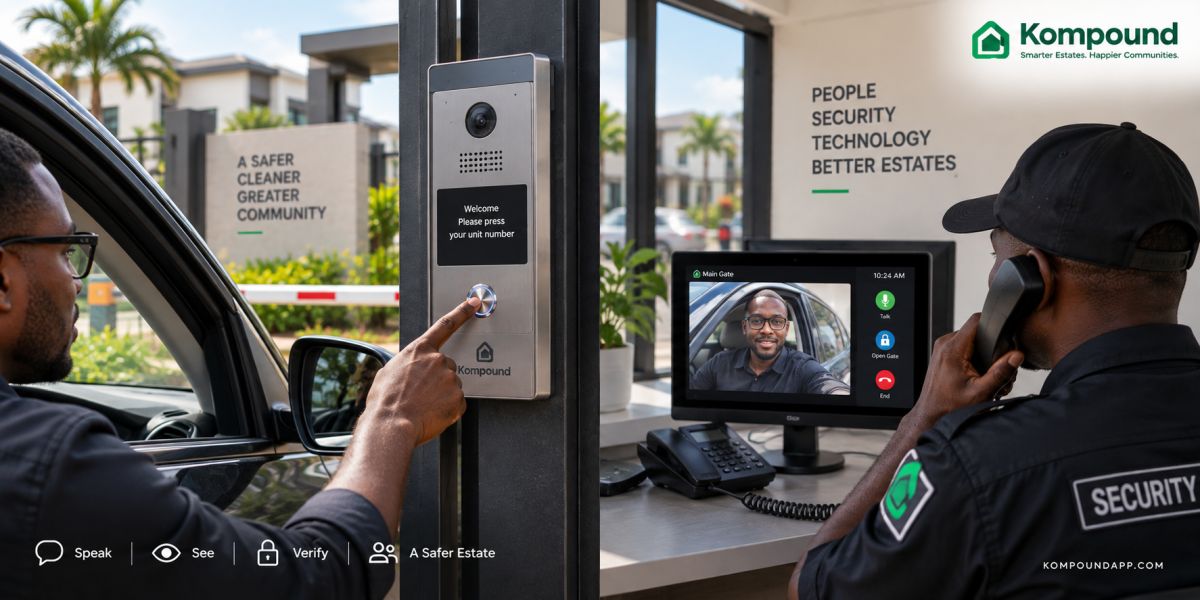
An intercom system gives your security team or residents a simple way to see or speak to someone at the gate before granting access.
For a Nigerian estate, that can be useful when you want to reduce unnecessary phone calls, confirm unexpected visitors, manage pedestrian entrances or give security another layer of verification.
But you should not buy an intercom simply because it looks like a security upgrade.
You first need to decide who will answer it, how many homes it needs to reach, whether you want video, what happens during a power failure and how it will work alongside your existing visitor-management system.
What is an estate intercom system?
An estate intercom connects your entrance with another person inside the estate.
That may be:
- Your gateman
- Security control room
- Estate office
- Individual homes
- Residents' mobile phones
When someone arrives, they can press a button or select a property.
The person receiving the call can then:
- Speak to the visitor
- See them where video is included
- Confirm why they are there
- Approve or reject access
- Unlock a pedestrian door or gate where supported
The system gives you a live conversation before access is granted.
Where an intercom actually fits
An intercom is most useful for situations where the visitor has not already been digitally pre-approved.
For example:
- Unexpected visitors
- Deliveries
- Contractors
- Pedestrians
- Service providers
- Visitors who cannot reach the resident
- Secondary entrances
- Office or clubhouse access
If your resident has already created a valid visitor pass, your gateman may not need to call them again.
That is why intercom works best as part of your wider access process, not as the only access-control tool.
Audio intercom or video intercom?
This is usually your first decision.
Audio intercom
An audio intercom lets the visitor and resident or security officer speak to each other.
It is simpler and usually cheaper.
It may be enough if your estate mainly needs:
- Voice confirmation
- Gate-to-office communication
- A simple call point
- Low-cost access communication
The limitation is obvious.
You can hear the person.
You cannot see them.
Video intercom
A video intercom adds a camera.
Now the person answering can see who is at the gate before approving access.
That gives you more context.
You may be able to see:
- Visitor
- Vehicle
- Delivery rider
- Contractor
- Activity around the gate
For many residential estates, video is the more useful upgrade because it combines voice communication with visual confirmation.
Analogue or IP intercom?
This is another important choice.
Traditional 2-wire or analogue intercom
A traditional intercom typically connects the entrance panel to indoor handsets or monitors through dedicated wiring.
It can work well for:
- Smaller estates
- Shorter cable runs
- Existing buildings
- Simple installations
The system can be relatively straightforward.
But expanding it later may require additional cabling.
IP intercom
An IP intercom works through your network.
That usually means Ethernet, CAT6 cabling, switches and sometimes Power over Ethernet.
This can make the system easier to scale across:
- Larger estates
- Multiple blocks
- Several entrances
- Estate offices
- Networked security systems
IP systems can also integrate more easily with other modern security equipment.
The trade-off is that your network design becomes part of the security system.
If your network is badly installed, your intercom will feel unreliable too.
What about app-based intercoms?
An app-based system can send the gate call directly to your resident's smartphone.
That means the resident may be able to answer even when they are not physically at home.
This can be useful for:
- Large estates
- Short-let properties
- Busy professionals
- Estates where residents do not want indoor monitors
- Multiple family members sharing access
It also reduces the need to install a physical monitor inside every home.
However, ask what happens when:
- The resident has no mobile data
- Their phone is off
- The app notification is delayed
- They changed phones
- Internet connectivity at the gate fails
Convenience is useful.
Reliability still matters more.
How much does an intercom system cost in Nigeria?
The cost depends heavily on the type of system.
A July 2026 Nigerian buyer guide gives indicative market ranges of roughly:
- ₦45,000–₦85,000 per unit for basic analogue or 2-wire intercom systems
- ₦85,000–₦180,000 per unit for IP video intercom systems
- ₦45,000–₦75,000 per flat for multi-unit estate intercom equipment, plus the central gate panel and wiring
- ₦120,000–₦250,000 per gate for some app-based intercom arrangements, before ongoing service charges where applicable
The same guide estimates a complete 50-unit estate video intercom installation at roughly ₦3 million–₦5.5 million, depending on wiring, indoor monitors and system type. These are indicative market figures rather than fixed quotations.
Your final cost may also include:
- Cabling
- Network switches
- PoE equipment
- Gate station
- Indoor monitors
- Power supplies
- Backup power
- Door release
- Electric lock
- Civil works
- Configuration
- Labour
Get a site-specific quotation before budgeting.
Do not price the intercom before counting the endpoints
Before asking for a quote, determine:
- Number of homes
- Number of gates
- Number of pedestrian entrances
- Number of indoor monitors
- Whether each flat needs its own unit
- Whether residents will use smartphones instead
- Distance from gate to buildings
- Existing network infrastructure
A 20-home compound and a 300-unit estate are completely different projects.
Should every house have an indoor monitor?
Not necessarily.
You have several possible designs.
One monitor per property
Useful where each household should receive gate calls directly.
Shared estate security intercom
The visitor speaks to your gateman or estate office.
Security then handles the verification.
Mobile app answering
Residents receive calls on their phones.
Hybrid arrangement
Security receives the initial call while certain entrances or premium units also have direct resident communication.
Choose the arrangement that matches how your estate actually operates.
Do not install 200 indoor monitors simply because the installer says that is the traditional design.
Where should the gate station be installed?
Your intercom panel should be easy for visitors to use.
Consider:
- Height
- Lighting
- Rain exposure
- Vehicle position
- Pedestrian position
- Camera angle
- Noise
- Accessibility
- Distance from the barrier
If your visitor has to leave their car and walk around the barrier just to press the button, your layout may create unnecessary congestion.
For vehicle entrances, position the intercom where a driver can reasonably reach or communicate with it.
Camera position matters
For a video intercom, the camera should show the visitor's face clearly.
Avoid installing it:
- Too low
- Too high
- Directly into strong sunlight
- Where headlights blind it at night
- Behind reflective glass
- Where vegetation blocks the view
Test the image during the day and at night.
Security equipment should be evaluated in the conditions where it will actually be used.
What about noise?
Estate gates can be noisy.
You may have:
- Generators
- Traffic
- Motorcycles
- Rain
- Security conversations
- Construction nearby
Ask to test the audio quality.
A beautiful intercom with poor sound becomes frustrating quickly.
You want both sides to hear each other clearly without shouting.
Wiring can become the expensive part
On a large estate, the intercom hardware may not be your biggest challenge.
Cabling can be.
Long distances may require:
- CAT6
- Fibre
- Dedicated conduits
- Network switches
- Junction boxes
- Surge protection
- Additional power supplies
If the estate is still under construction, plan intercom infrastructure early.
Installing conduit before roads, walls and landscaping are finished is much cheaper than breaking them later.
Can you use wireless intercom?
Yes, but be careful.
Wireless systems can reduce cabling, but reliability depends on:
- Signal strength
- Distance
- Walls
- Interference
- Internet availability
- Power
For a small compound, wireless may be perfectly adequate.
For a large estate where access depends on the system every day, a properly designed wired or managed network connection is usually easier to control.
Power backup is essential
Your intercom should not disappear every time power fails.
Identify everything that needs electricity:
- Gate station
- Indoor monitor
- Network switch
- Router
- Electric lock
- Door controller
Then decide what should be connected to:
- UPS
- Inverter
- Battery backup
- Generator
- Solar where appropriate
If your intercom opens a door electronically, make sure you also understand how that door behaves during power failure.
Should an intercom open the gate?
It can.
Some systems allow the person answering the call to trigger:
- Electric strike
- Magnetic lock
- Pedestrian gate
- Motorised gate
- Compatible access controller
That can be convenient.
But the person granting access should still understand who they are letting in.
Communication and access control should work together.
Intercom vs visitor code
You do not necessarily choose one.
They solve different situations.
Visitor code
Best when the resident already expects the visitor.
The resident creates access before arrival.
Intercom
Useful when someone arrives without prior approval or needs direct communication.
A well-designed estate can use both.
For example:
Expected visitor → visitor code
Unexpected visitor → intercom verification
That reduces calls while preserving a clear fallback.
Intercom vs CCTV
They also perform different jobs.
CCTV lets you monitor and review activity.
An intercom lets you communicate.
A camera may show you who is standing at the gate.
It does not automatically let you speak to them.
A video intercom combines some of both, but it usually has a narrower field of view than a dedicated CCTV system.
Your estate may need:
- CCTV for wider monitoring
- Intercom for communication
- Access control for permission
- Gate hardware for physical movement
Do not expect one device to perform every security function.
What should you check before buying?
Ask the installer or vendor:
- Is this audio or video?
- Is it analogue or IP?
- How many homes can it support?
- Can you expand it later?
- Does it support mobile answering?
- Can it connect to an electric lock?
- Can it connect to your gate controller?
- Does it have night vision?
- What is the weather rating?
- What happens during power failure?
- What happens during network failure?
- Are spare parts available?
- Who provides maintenance?
- What is the warranty?
Get those answers before installation.
Common mistakes to avoid
Installing an intercom without deciding who answers
Someone needs to own the call.
Buying video without checking night performance
The daytime demo is not enough.
Ignoring power backup
Security systems should not vanish during an outage.
Installing poor cabling
Your expensive device will still behave badly on a weak network.
Making residents answer every visitor
Use visitor pre-approval for expected guests.
Forgetting pedestrians
Your vehicle gate may not be the only place where visitors arrive.
Installing screens nobody wants
Consider whether app-based answering makes more sense for some estates.
Treating intercom as your entire security system
It is one layer.
How intercom fits with Kompound
Kompound's existing gate workflow focuses on resident-approved visitor passes, gate verification, entry and exit records and compatible access-control hardware. Its current hardware offering includes keypads, QR verification, boom barriers, pedestrian access and central gate control.
An intercom can complement that process.
Your expected visitor may already have a Kompound pass.
Your unexpected visitor may need live communication with security or the resident.
Your estate can therefore design a gate process where communication, verification and physical access each have a clear role.
The goal is not to install every device available.
It is to build a gate that is easier to operate and harder to bypass.
Want help planning your estate gate?
If you are considering an intercom alongside visitor codes, QR verification, pedestrian access or a boom barrier, start with the entrance itself.
We can review how your estate currently handles visitors and show you where Kompound fits into the process.
That helps you avoid buying hardware first and trying to design the workflow afterwards.
Frequently asked questions
What is the best intercom system for an estate?
It depends on your estate size, number of gates, distance between buildings, whether you need video and whether residents should answer through indoor monitors or smartphones.
Is a video intercom better than audio?
Video gives you additional visual verification.
If budget allows and gate security is important, it can be more useful than audio-only communication.
How much does an intercom system cost in Nigeria?
Current indicative 2026 market ranges vary from tens of thousands of naira per basic unit to several million naira for a complete multi-unit estate installation. Cabling and infrastructure can make a significant difference.
Can residents answer an estate intercom on their phones?
Yes, some IP and cloud-based systems support smartphone answering.
Can an intercom open a gate?
Yes, where it is connected to a compatible lock, gate controller or access-control system.
Do you still need visitor codes if you have an intercom?
They can work together.
Visitor codes are useful for pre-approved visitors, while intercom is useful when live communication is needed.
Can an intercom work during a power failure?
Only if the required equipment has backup power or another fallback arrangement.
Should you use IP or analogue intercom?
For a small, simple installation, analogue may be enough.
For larger estates, multiple entrances or future expansion, IP systems are often easier to scale.
The simple decision
Choose your intercom based on how your gate actually works.
If you only need basic communication, audio may be enough.
If you need visual confirmation, use video.
If you need many homes and future expansion, consider IP.
If residents need to answer from anywhere, consider app-based communication.
And if most visitors are already expected, combine the intercom with a proper pre-approved visitor system so your gate is not calling residents unnecessarily.