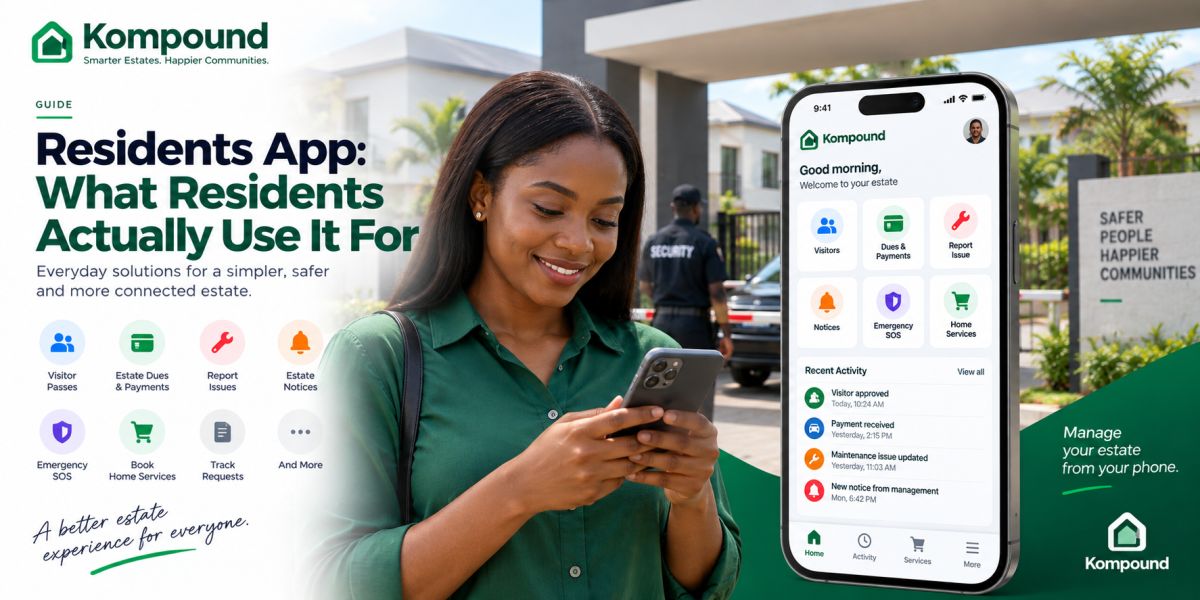
If you are introducing an app into your estate, your residents are unlikely to care how many features it has.
They care about whether it makes everyday estate life easier.
Can you let your visitor in without calling the gate?
Can you see what you owe?
Can you confirm a payment?
Can you report a broken streetlight?
Can you receive an important estate notice without searching through hundreds of WhatsApp messages?
Can you quickly call for help in an emergency?
That is what determines whether residents actually use an estate app.
A good residents app should remove small frustrations from everyday living.
What is an estate residents app?
An estate residents app is the resident-facing part of an estate management system.
It gives you a direct way to interact with your estate from your phone.
Depending on the platform, you may be able to:
- Approve visitors
- View estate dues
- Make payments
- Receive notices
- Report maintenance problems
- Raise emergency alerts
- Review payment records
- Book home services
- Track requests
- Manage household access
The best resident apps do not try to make you feel like an estate administrator.
They simply make common tasks easier.
1. Letting your visitors in
This is usually one of the most useful features.
Without a digital visitor system, the process often looks like this:
Your visitor arrives.
The gateman asks who they are visiting.
Security calls you.
You miss the call.
They call again.
Your visitor waits.
Cars begin waiting behind them.
A resident app can move that approval before arrival.
You create a visitor pass.
Your visitor receives a temporary code or digital pass.
Security verifies it when they arrive.
The visit is recorded.
You do not have to answer a gate call every time someone comes to see you.
Kompound's current resident app allows residents to generate visitor access codes, manage visitor entries and receive visitor-related notifications.
2. Seeing what you owe the estate
You should not need to message the treasurer every time you want to confirm your estate balance.
A useful residents app should let you see charges connected to your property.
That may include:
- Estate dues
- Service charges
- Security levies
- Special levies
- Shared utilities
- Other approved charges
More importantly, you should understand what you are being asked to pay.
Good estate software creates a clearer connection between:
the charge → your payment → your updated balance.
That reduces unnecessary disputes between residents and management.
3. Keeping your payment history
You probably already keep transfer receipts.
The problem is that receipts can disappear into your photo gallery, email or WhatsApp history.
A resident app can give you a more organised record.
Depending on the platform, you may be able to see:
- Previous payments
- Transaction history
- Receipts
- Outstanding charges
- Payment confirmations
Kompound currently includes payment history and digital receipts within its resident experience, while estate dues and billing form part of the broader platform.
That means when someone asks:
> “Did you pay the security levy?”
you should not have to search through six months of bank alerts.
4. Reporting something that is broken
Imagine the streetlight beside your house stops working.
Normally, you might post:
> “Please, this streetlight has been bad since last week.”
Someone responds.
Another person tags the estate manager.
The conversation moves on.
A week later, nobody knows whether anything happened.
A better resident app allows you to report the issue directly.
You should ideally be able to:
- Describe the problem
- Add relevant information
- Submit it
- See its status
- Know when it has been resolved
Kompound currently allows residents to submit estate issues and follow maintenance or service requests through the app.
That is much more useful than hoping someone remembers a WhatsApp message.
5. Receiving estate notices
WhatsApp groups are useful.
They are also noisy.
An important message can quickly disappear underneath conversations about:
- Parking
- Power
- Lost items
- Deliveries
- Recommendations
- Neighbour disputes
- General greetings
Your residents app should give you a separate place for official estate information.
That can include:
- AGM notices
- Security alerts
- Water shutdowns
- Planned maintenance
- Payment reminders
- New estate rules
- Emergency information
- Community announcements
Kompound supports estate announcements and push notifications, while keeping a record of what management communicated to residents.
WhatsApp can remain useful for discussion.
The estate app becomes the place for information you may need to find again.
6. Calling for help during an emergency
An emergency feature should be simple.
If you need help, you should not have to search through your contacts for the right security number.
A resident app can provide an SOS or emergency function connected to estate security.
The important thing is what happens after you press it.
You should know:
- Who receives the alert
- Whether your location can be shared
- How security responds
- Whether the incident is recorded
Kompound's privacy policy says location is used when a resident raises an SOS so estate security can locate the person, and it is not used for continuous location tracking.
That is the kind of emergency workflow worth understanding before your estate adopts a platform.
7. Booking someone when something breaks inside your home
Estate problems do not stop outside your front door.
You may need:
- A plumber
- Electrician
- AC technician
- Cleaner
- Carpenter
- Painter
- Other skilled professional
Finding somebody is easy.
Finding somebody you trust is harder.
A resident platform can make that process more organised by allowing you to request a service, receive quotations and track the work.
The current Kompound Resident app includes a home-services marketplace where you can request professionals such as plumbers, electricians, painters, cleaners, AC technicians and carpenters, compare quotations and follow the job through completion.
For a resident, that can make the app useful even on days when you have no reason to contact estate management.
8. Receiving updates without chasing anyone
A good resident app should reduce questions such as:
> “Has my payment gone through?”
> “Has my visitor entered?”
> “Has anybody attended to my complaint?”
> “What happened to the plumber I requested?”
Notifications can keep you informed about events that actually affect you.
Kompound currently lists notifications for visitor activity, payment confirmations, maintenance progress, booking updates and estate announcements.
The important thing is not receiving more notifications.
It is receiving the right ones.
What residents probably will not use
This is equally important.
Residents generally do not want an app overloaded with administrative screens they do not need.
You should not have to understand:
- Estate accounting
- Gate configuration
- Administrative permissions
- Security reports
- Staff management
- Hardware settings
Those functions belong with management or security.
A good estate platform should give each person the tools relevant to their role.
Kompound currently separates its platform into a resident app, gate app and admin panel for this reason.
You get the resident experience.
Your gateman gets the gate tools.
Your EXCO or management team gets the administrative records.
Does every resident need a smartphone?
Not necessarily.
This matters in estates with elderly residents, domestic staff or households where not everyone wants another app.
Kompound says visitor passes can still be shared as ordinary codes through messaging or even verbally, so every individual involved in a visit does not need the app installed.
Your estate should therefore ask:
Which activities genuinely require the app, and which should still have a practical fallback?
That usually creates better adoption than forcing technology into every situation.
Should residents have to pay for the app?
This depends on the provider's pricing model.
You should understand whether residents are charged:
- For downloading the app
- For creating visitor passes
- For reporting issues
- For SOS access
- For making payments
- For optional services
Kompound currently says the resident app is free to households on participating estates, including visitor passes, SOS and issue reporting. Optional purchases or services may still carry their own cost.
Always ask what is included before your estate signs up.
What makes residents actually adopt an estate app?
The answer is not compulsory installation.
It is usefulness.
Residents are more likely to keep using an app when it saves them from something irritating.
For example:
Instead of calling security, you create a visitor pass.
Instead of asking the treasurer, you check your dues.
Instead of posting a complaint repeatedly, you track it.
Instead of searching through a WhatsApp group, you find the notice.
Instead of looking randomly for an artisan, you request one through the platform.
The app earns its place on your phone one useful action at a time.
What should your estate check before choosing a residents app?
Try it as a resident.
Do not only watch the administrator demonstrate it.
Download or open the resident side and attempt the common tasks yourself.
Try to:
- Create a visitor pass
- Find your estate dues
- Check a payment
- Report an issue
- Find an announcement
- Locate the emergency function
- Request a service
Then ask yourself:
Could your average resident do this without someone standing beside them?
If the answer is no, adoption may become difficult.
Common mistakes estates make
Giving residents too many features
More is not automatically better.
Focus on the things people actually need.
Making simple tasks complicated
A visitor pass should not require a tutorial.
Requiring residents to use both the app and WhatsApp for the same process
Choose where the official record lives.
Introducing the app without explaining the benefit
Do not tell residents:
> “You must download this.”
Explain:
> “This is how you will approve visitors, check dues and report issues.”
Ignoring older or less technical residents
Keep practical alternatives where they are genuinely necessary.
Sending too many notifications
If everything is urgent, residents will eventually ignore everything.
How Kompound approaches the resident experience
Kompound is designed so your daily estate interactions can happen from one resident app.
That currently includes:
- Visitor passes
- Estate notices
- Dues and payments
- Issue reporting
- SOS
- Service requests
- Home-service bookings
- Payment history
- Notifications
The wider platform connects what you do as a resident with what your estate management and security teams need to see.
That connection is important.
You should not have to create a visitor pass in one system, report an issue in another and check your estate bill somewhere else.
Want to see what your residents would actually get?
If your estate is considering an app, do not make the decision based only on the management dashboard.
See the resident experience too.
We can show you how a household creates a visitor pass, sees estate charges, reports an issue, receives notices and interacts with your gate and management team through Kompound.
Bring your EXCO, facility manager or security supervisor if you want.
We will walk you through the system using the kind of situations your estate already handles every day.
Frequently asked questions
What is an estate residents app?
It is the resident-facing part of an estate management platform.
It allows you to perform everyday estate tasks such as approving visitors, checking dues, receiving notices and reporting issues from your phone.
What should a residents app include?
At minimum, look for features that solve frequent resident problems.
That may include:
- Visitor access
- Estate charges
- Payment records
- Issue reporting
- Notices
- Emergency support
Additional services may be useful depending on your estate.
Can you use an estate app to approve visitors?
Yes.
Many resident apps allow you to create a temporary visitor credential before your visitor arrives.
Security then verifies it at the gate.
Can residents pay estate dues through an app?
Yes, depending on the platform.
A good system should also maintain enough payment information for you and estate management to understand what was paid and what remains outstanding.
Can you report maintenance issues through an estate app?
Yes.
This is often more useful than posting maintenance complaints repeatedly in a group chat because the issue can be tracked until it is resolved.
Does everyone in your household need the app?
Not always.
The exact arrangement depends on the platform and your estate's rules.
For example, visitor codes can often be shared with someone who does not have the app.
Is a residents app better than WhatsApp?
They do different jobs.
WhatsApp is excellent for conversation.
A residents app is better suited to structured tasks such as visitor approvals, dues, issue tracking and keeping official estate records.
Your estate may continue using both.
The simple test
Your residents do not need an app because estate technology sounds modern.
They need it because it makes living in the estate easier.
If you can:
approve a visitor faster, understand your payments, report a problem properly and get important information without chasing anyone,
the app is doing something useful.
That is what residents actually care about.