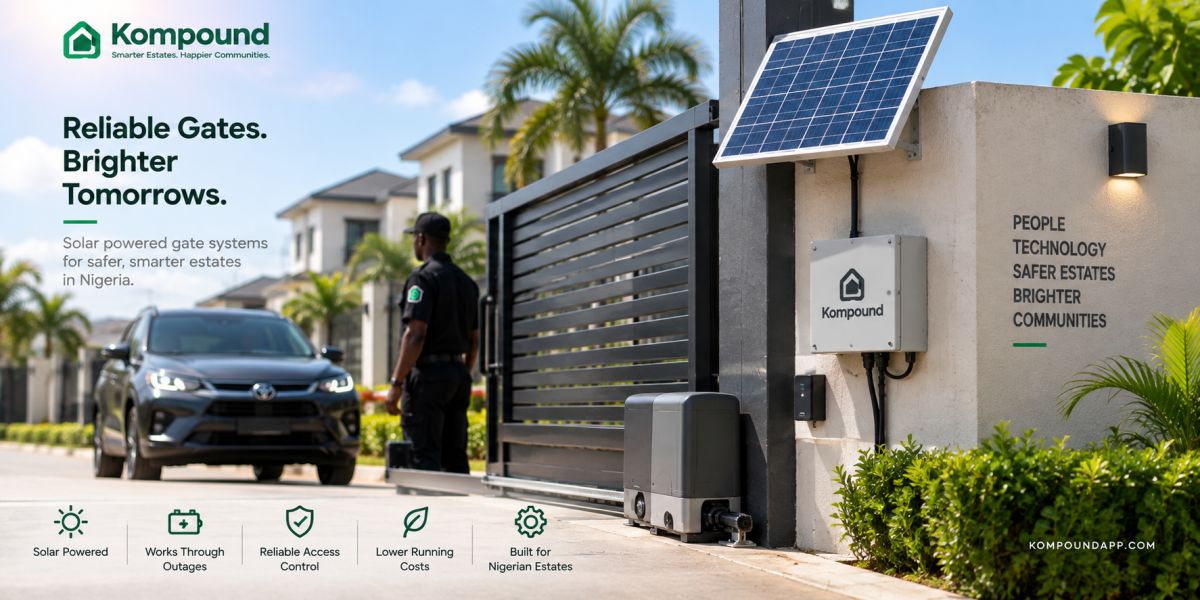
A solar-powered estate gate can keep working when public power fails, reduce dependence on your generator and make gate automation practical where reliable mains electricity is difficult.
But simply connecting a solar panel to a gate motor does not give you a reliable solar gate.
You need the right combination of:
- Gate motor
- Solar panel
- Battery
- Charge controller
- Safety sensors
- Access controller
- Backup arrangement
- Proper installation
And you need to size those components for your actual gate and traffic.
If your estate opens the gate 300 times a day, you should not use the same solar setup as a private compound opening it 20 times.
Here is what you should know before buying.
What is a solar-powered gate system?
A solar-powered gate uses photovoltaic panels to generate electricity for the gate automation system.
The solar panel charges a battery.
The battery then supplies power to the motor and control equipment when the gate needs to open or close.
Depending on your setup, the system may power:
- Sliding gate motor
- Swing gate motor
- Boom barrier
- Gate controller
- Safety sensors
- RFID reader
- Keypad
- QR reader
- Other access-control equipment
Some systems operate completely from solar.
Others use solar as part of a hybrid system with grid electricity, inverter power or generator backup.
For many Nigerian estates, the hybrid approach can give you more resilience.
When solar makes sense for your estate
Solar becomes particularly useful when your gate suffers from frequent power interruptions.
You may also consider it when:
- The gate is far from your main power supply
- Running a new mains cable would be expensive
- You want access control available during outages
- Generator fuel is being used mainly to keep security systems alive
- You are installing automation at a remote entrance
- Your gate motor already supports low-voltage DC operation
- You want a dedicated backup system for the gate
Solar can make your gate more independent.
It does not automatically make it maintenance-free.
The first thing to check is your gate motor
Not every motor should be connected to the same solar arrangement.
Start with the motor's specifications.
Check:
- Voltage
- Power consumption
- Gate weight rating
- Duty cycle
- Maximum number of operations
- Battery compatibility
- Solar compatibility
Many solar-friendly gate motors use 12V or 24V DC systems because batteries can supply them more directly.
For example, one current Nigerian swing-gate operator is rated at 24V DC, around 60W motor power and supports optional battery and solar equipment.
But that does not mean every 24V motor can use the same panel and battery.
You still need to calculate the load.
Your gate weight matters
Before choosing a motor, know what you are trying to move.
For a sliding gate, consider:
- Gate weight
- Gate length
- Track condition
- Wheel condition
- Gradient
- Resistance
For a swing gate, consider:
- Weight of each leaf
- Width of each leaf
- Hinge condition
- Wind exposure
- Opening angle
A motor rated for a 600kg sliding gate should not automatically be used on a badly aligned 600kg gate.
The motor rating assumes the gate itself operates properly.
Fix mechanical problems before adding automation.
How the solar system actually works
A simple arrangement looks like this:
Solar panel → charge controller → battery → gate motor and controller
During daylight, the panel generates power and recharges the battery.
The battery supplies energy whenever the gate operates.
At night, the battery becomes your primary source.
The important part is therefore not just producing enough power during the day.
You also need enough stored energy to survive the periods when solar production is low.
Do not size the solar panel alone
One of the most common mistakes is asking:
How many watts of solar panel do I need?
That question is incomplete.
You need to calculate the entire system.
Your installer should consider:
- Motor power
- Standby consumption
- Number of gate cycles per day
- Other equipment connected
- Battery voltage
- Battery capacity
- Desired backup duration
- Solar conditions
- Charging losses
- Future equipment
The system should be sized around energy demand, not around whichever panel the installer happens to have available.
Count how many times your gate opens each day
This matters more than many buyers realise.
Consider two properties.
Small compound
20 opening and closing cycles per day.
Large residential estate
250 opening and closing cycles per day.
They may use similar-looking gates.
Their energy requirements are not the same.
Estimate:
- Morning traffic
- Evening traffic
- Visitors
- Deliveries
- Contractors
- Weekend traffic
- Peak periods
If your estimate is 150 cycles per day, do not design the solar system around 50.
Give yourself reasonable headroom.
Your battery is as important as your panel
Solar does not operate your gate only when the sun is shining.
Your battery stores the energy.
That means poor battery sizing can make an otherwise good installation frustrating.
Your battery needs enough capacity to support:
- Night-time operation
- Cloudy periods
- Morning traffic before strong sunlight
- Standby electronics
- Safety equipment
- Any connected readers or controllers
You should also decide how much autonomy you want.
For example:
How long should your gate operate without meaningful solar charging?
One day?
Two days?
Three days?
That decision affects battery size.
Some imported solar gate kits advertise several days of battery backup, but those claims depend on gate usage and load. One currently listed sliding gate kit, for example, includes a 20W solar panel and built-in battery while claiming 3–5 days of backup for its intended use.
Treat manufacturer backup claims as a starting point, not a guarantee for your estate.
Do not forget standby power
Your motor only runs for a few seconds each time.
But other equipment may remain powered all day.
That can include:
- Access controller
- RFID reader
- QR terminal
- Keypad
- Network equipment
- Intercom
- Sensors
- Indicator lights
Those loads can consume energy continuously.
A solar system sized only for the motor may therefore be too small once you connect everything else.
Ask your installer to list every device the solar system is expected to power.
CCTV should usually be considered separately
Do not assume your small gate-motor solar panel will also power:
- Several CCTV cameras
- NVR
- Router
- Floodlights
- Intercom
- Boom barrier
- Access readers
It may be possible to create one integrated solar system.
But it has to be sized for the full load.
Sometimes separating your access-control power from your CCTV or general security power makes the system easier to design and maintain.
How big should your solar panel be?
There is no universal answer.
You can find very small solar panels supplied with low-energy residential systems.
For example, one solar swing-gate kit sold in Nigeria includes a 10W 12V panel and 12V 7Ah battery for a specific 12V swing-gate operator.
At the other end, a current Nigerian listing for a 1,500kg gate operator includes two 20W panels, two 12V 9Ah batteries and a 20A solar charge controller.
Those examples show why you should not copy somebody else's panel size.
Different motors have different requirements.
Different gates have different traffic.
Get the system sized for your installation.
Where should the solar panel go?
Your panel needs good exposure to sunlight.
Avoid installing it where it is heavily shaded by:
- Gatehouse roof
- Trees
- Walls
- Buildings
- Signboards
- Other structures
Even if the location looks sunny at noon, observe it across the day.
A panel that falls into deep shade for much of the afternoon may not recharge the battery as expected.
The mounting structure should also be secure against:
- Wind
- Accidental damage
- Theft
- Tampering
Your battery location matters too
Batteries and electronics should not simply be placed anywhere near the gate.
Your installer should consider:
- Weather protection
- Ventilation where required
- Heat
- Water
- Flood risk
- Accessibility
- Security
- Cable length
Do not place critical electrical equipment where the first heavy rain can flood it.
Use appropriate enclosures.
What happens after several cloudy days?
This is where system design matters.
A well-sized system includes enough battery storage and charging capacity to handle reasonable periods of poor solar production.
But no battery contains unlimited energy.
For a mission-critical estate entrance, consider whether you also want another charging source.
A hybrid arrangement can allow charging from:
- Solar
- Grid
- Inverter
- Generator
That gives you another layer of resilience.
Solar does not have to mean solar-only.
Solar gate vs ordinary gate with battery backup
These are not exactly the same.
Battery backup
Your mains supply normally powers the gate and charges the battery.
When electricity fails, the battery takes over.
Solar-powered system
The solar panel contributes or supplies the energy used to recharge the battery.
Hybrid system
Solar, mains electricity and battery storage work together.
Which one makes sense depends on your power situation.
If your estate has relatively reliable electricity and short outages, battery backup may be enough.
If your gate experiences long outages or is located far from mains power, solar becomes more attractive.
What does a solar-powered gate cost in Nigeria?
There is no single reliable price because sellers use the phrase “solar gate” for very different packages.
Current Nigerian examples include:
- A solar-compatible 24V sliding gate motor rated for up to 1000kg, supplied with solar panel and gear rack, listed around ₦800,000 on Konga.
- A 1,500kg smart gate operator package with dual solar panels and two batteries listed around ₦850,000.
- A dedicated 3–6 metre solar boom barrier system listed at about ₦1.5 million by a Nigerian security-equipment supplier.
These are product examples, not fixed market rates.
Your complete cost can increase when you add:
- Installation
- Civil works
- Gate repairs
- Additional batteries
- Larger solar panels
- Mounting structure
- Safety sensors
- Access controller
- RFID
- QR reader
- Cabling
- Surge protection
- Boom barrier integration
Get a complete quotation.
Do not compare one seller's motor-only price with another seller's installed solar system.
Is solar more expensive than ordinary gate automation?
Usually, your upfront cost will be higher because you are adding:
- Solar panel
- Battery
- Charge controller
- Mounting equipment
- Additional electrical work
A normal automatic gate installation in Nigeria can already range from several hundred thousand naira upward depending on the gate and equipment. A current 2026 Nigeria cost guide places many automatic gate installations around ₦400,000–₦800,000, with heavier systems costing more, before specialised solar additions.
The reason to consider solar is not simply to find the cheapest installation.
It is to improve power independence and gate availability.
Your gate still needs a manual release
Every automatic gate should have a practical fallback.
Even with:
- Solar
- Battery
- Generator
- Grid electricity
something can still fail.
Your security team should know how to release or operate the gate manually when necessary.
Some current solar-capable systems specifically include manual emergency release mechanisms.
Do not wait for an emergency before teaching your guards how it works.
Safety sensors still matter
Solar power does not change the safety requirements of the gate.
Your system may need:
- Photocells
- Loop detectors
- Obstacle detection
- Auto-reverse
- Warning lights
- Manual release
A solar-powered gate can still injure someone if the safety system is badly designed.
Do not remove sensors to reduce energy consumption or installation cost.
Size your power system properly instead.
Your solar gate can still use access control
Solar only answers the power question.
You still need to decide who is allowed to open the gate.
Your estate may use:
- Resident RFID
- UHF vehicle stickers
- Number-plate recognition
- Visitor codes
- QR passes
- Keypads
- Security approval
- Remote control
The access controller decides whether access is authorised.
The motor physically moves the gate.
The solar system keeps the equipment powered.
Those are three separate parts of the system.
Remote control alone is not full access control
A remote may open your gate.
But it may not tell you:
- Who entered
- Which resident authorised them
- When they entered
- Whether a visitor pass expired
- Whether the vehicle should still have access
For a private home, remote control may be enough.
For a residential estate, you may want more accountability.
That is where access-control software becomes useful.
Maintenance is not optional
A solar gate has everything a normal automatic gate has, plus additional power equipment.
Your maintenance plan should include:
Gate mechanics
Check:
- Wheels
- Track
- Hinges
- Alignment
- Motor
- Gear rack
Solar panel
Check:
- Dirt
- Leaves
- Shade
- Damage
- Loose mounting
Battery
Check:
- Capacity
- Connections
- Physical condition
- Charging behaviour
Electrical system
Check:
- Controller
- Wiring
- Fuses
- Terminals
- Enclosure
- Surge protection
Safety equipment
Check:
- Photocells
- Loop detectors
- Obstruction detection
- Manual release
Do not wait until residents are trapped outside before inspecting the system.
Battery replacement should be in your budget
Solar panels can last a long time.
Batteries are consumable components.
Their lifespan depends on:
- Battery chemistry
- Temperature
- Depth of discharge
- Charging quality
- Usage
- Installation conditions
Your estate should therefore treat battery replacement as a predictable maintenance expense.
Do not design a system whose operating budget assumes the original battery lasts forever.
Common mistakes to avoid
Buying because the motor says “solar compatible”
Compatibility does not mean the supplied solar system is correctly sized for your estate.
Using an undersized battery
Your gate may work beautifully during the day and fail at night.
Ignoring traffic volume
More gate cycles mean more energy consumption.
Powering too many devices from a tiny kit
Count the complete load.
Installing the panel in shade
Good equipment cannot compensate for poor solar exposure.
Ignoring gate mechanics
A badly aligned gate forces the motor to work harder.
Forgetting backup access
Your guards still need a manual procedure.
Buying without local support
Ask who repairs the motor, controller and solar equipment.
How solar power can support Kompound gate operations
Kompound handles the access-management side of your estate gate.
Your residents can create visitor access.
Your security team can verify approved visitors.
Your gate can keep organised access records.
Compatible hardware can then form part of the physical entry system.
A solar-powered setup can help keep supported gate hardware available during electricity interruptions.
That means your design can combine:
Kompound access management + gate controller + gate motor or boom barrier + battery + solar charging.
The exact hardware depends on your gate.
You do not need to buy every component at once.
The important thing is designing the power, access and physical gate systems to work together.
Planning a solar-powered gate for your estate?
Do not start by buying a solar panel.
Start with your gate.
Your gate type, weight, daily traffic, number of entrances, access-control requirements and power situation all affect the correct setup.
We can show you how Kompound fits into your visitor and gate workflow and help you understand where compatible automation can be added.
Frequently asked questions
Can an automatic estate gate run completely on solar?
Yes, where the motor and solar system are correctly designed for the load.
Some gate operators are specifically sold as solar-capable or solar-only systems.
How many solar panels do you need for an automatic gate?
There is no universal number.
It depends on the motor, battery, number of daily gate cycles and other equipment being powered.
Can a solar gate work at night?
Yes.
The gate normally uses energy stored in the battery when solar generation is unavailable.
What happens during several cloudy days?
A properly sized battery provides reserve capacity, but the available autonomy depends on battery size and system load.
A hybrid charging arrangement can provide additional backup.
Can solar power a boom barrier?
Yes.
Solar boom barrier systems are currently available in the Nigerian market.
Can solar power a sliding gate?
Yes.
Solar-compatible sliding gate operators are also sold in Nigeria.
Can you add solar to an existing automatic gate?
Often yes, especially when the motor supports compatible DC and battery operation.
An installer should inspect the existing motor and controller before you buy solar equipment.
Does a solar gate still need batteries?
In most practical setups, yes.
The battery stores energy so the gate can operate at night and when solar generation is low.
Can you connect RFID or visitor codes to a solar gate?
Yes.
Solar provides the power.
Your access-control system determines who is authorised.
Is solar worth it for an estate gate?
It can be particularly valuable when power interruptions regularly affect gate operations or running reliable mains electricity to the entrance is difficult.
The decision should be based on reliability and total operating needs, not only electricity savings.
The simple decision
Solar makes sense when you need your gate to remain available without depending entirely on public electricity or a running generator.
But the quality of the installation matters more than the word solar on the quotation.
Get the motor right.
Size the battery properly.
Size the solar panels for the real load.
Protect the equipment.
Maintain the gate.
Then connect it to an access process that your residents and security team can actually use.