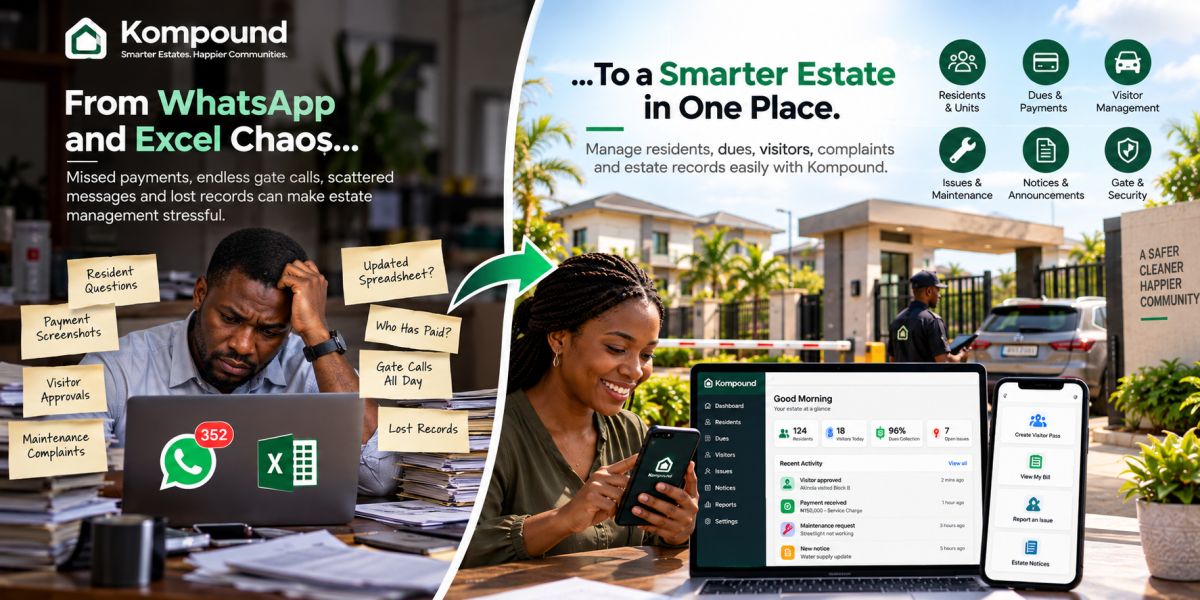
# How to Manage an Estate Without WhatsApp and Excel
If you want to manage an estate without WhatsApp and Excel, you do not need to throw away every tool your EXCO currently uses.
You need to stop asking those tools to do jobs they were never designed to do.
WhatsApp is excellent for conversation.
Excel is useful for calculations and analysis.
The problem starts when WhatsApp becomes your notice board, complaint tracker, visitor system and permanent archive while Excel becomes your resident register, dues ledger, payment tracker and handover file.
That arrangement can work when your estate is small.
As the community grows, information starts spreading across too many places.
One person has the resident list.
Another has the latest dues spreadsheet.
Payment screenshots are in private chats.
The gateman has a notebook.
Maintenance complaints are buried in the residents group.
The chairman has important information on their phone.
Then somebody leaves the EXCO and everyone discovers how much of the estate depended on one person.
A better system does not necessarily mean adding more technology.
It means creating one reliable place for the estate information that should not depend on individual people.
Why WhatsApp and Excel Start to Fail as Your Estate Grows
The problem is not that either tool is bad.
The problem is fragmentation.
Imagine a resident pays a ₦150,000 service charge.
The treasurer receives the bank alert.
The resident sends the payment screenshot on WhatsApp.
Someone updates a spreadsheet.
Another EXCO member has an older copy of the same spreadsheet.
Three months later, the resident receives a reminder saying they still owe money.
Now everybody begins searching.
The resident searches their banking app.
The treasurer searches WhatsApp.
The secretary searches Excel.
Management searches the bank statement.
You eventually find the payment, but several people have wasted time proving something the estate should already know.
The same problem happens with visitors.
Your resident sends the gate a message.
The visitor arrives.
The gateman cannot find the message.
Security calls the resident.
The resident does not answer.
Cars begin queuing.
Or consider maintenance.
A resident reports a leaking pipe in the group.
Twenty people reply.
Someone says a plumber will come.
Two weeks later, the problem is still there and nobody can clearly say who was responsible.
The underlying issue is the same in every example:
the estate has information, but it does not have a reliable workflow.
That is usually the point where adding more WhatsApp groups or more spreadsheet columns stops helping.
What a Better Estate Management System Should Replace
Before you choose any software, identify what should become structured.
You do not need to digitise every conversation in the estate.
Focus on information that needs to remain accurate over time.
Resident and property records
You should have one organised register showing the properties in the estate and the people connected to them.
When a tenant moves out, you update the record.
When a new household moves in, you add them.
When the EXCO changes, the resident register stays with the estate.
Estate dues
Every charge should connect to the property or resident expected to pay it.
You should be able to see:
- What was billed
- What was paid
- What remains outstanding
- Whether a part payment was made
- What the payment was for
That is much stronger than maintaining one spreadsheet and waiting for residents to send screenshots.
Visitor access
Residents should have a clear way to approve visitors.
Security should have a clear way to verify that approval.
The estate should be able to record entry and exit where required.
This removes unnecessary gate calls and gives your security team a more reliable process.
Read: Visitor Management for Nigerian Estates
Complaints and maintenance
If a resident reports a broken streetlight, the report should become an issue that somebody can assign, update and close.
It should not disappear underneath weekend messages in the estate group.
Official notices
You can still use WhatsApp.
But important notices should also live somewhere residents can find them again.
That might include:
- AGM notices
- Security information
- Water shutdowns
- New estate rules
- Service-charge announcements
- Maintenance updates
Estate history
Your association should preserve important records even when the people running it change.
That includes resident information, dues, payment history, important notices and operational records.
The more your estate depends on individual phones and personal files, the harder every future handover becomes.
How Do You Move Away Without Disrupting Residents?
Do not wake up on Monday and announce that everything has changed.
That usually creates resistance.
Move the estate in stages.
Start with the problem causing the most pain.
If visitor calls are frustrating residents, start there.
If the treasurer is spending hours reconciling dues, start with billing and payments.
If resident information is a mess, clean the register first.
A sensible transition might look like this:
Step 1: Clean your resident records
Before moving information into any system, make sure it is accurate.
Remove duplicate records.
Identify former residents.
Confirm property numbers.
Update contact information.
Do not migrate bad data simply because it already exists.
Step 2: Create your estate structure
Set up the streets, houses or units properly.
Your digital structure should match the estate residents actually recognise.
Step 3: Move one important workflow
Visitor management is often a good starting point because residents quickly understand the benefit.
Instead of waiting for gate calls, they create their own visitor passes.
Another estate may start with dues because payment tracking is its biggest problem.
There is no rule saying every estate has to follow the same order.
Step 4: Train the people doing the work
Your gatemen need to understand the gate interface.
Your treasurer needs to understand billing and payment records.
Your administrator needs to understand resident management.
Residents only need to understand the actions relevant to them.
Do not train everybody on everything.
Step 5: Define which system becomes the official record
This matters.
If your payment system says a resident owes ₦50,000 while somebody's personal Excel file says ₦80,000, which one is correct?
Once the migration is complete and verified, agree where the official record lives.
That prevents your estate from operating two parallel systems forever.
What You Should Digitise First
Start with the activities that happen repeatedly.
Those usually produce the fastest benefit.
Residents and units
Everything else depends on knowing who belongs to which property.
Your resident database becomes the foundation.
Visitor management
This touches residents and security every day.
A smooth visitor process can immediately reduce gate calls and queues.
Dues and payments
Once charges and balances connect directly to resident accounts, your treasurer spends less time reconstructing payment history.
Issues
Give residents a structured way to report maintenance or estate problems.
Management can then see what remains unresolved.
Notices
Keep official communication separate from everyday conversation.
That does not mean closing your WhatsApp group.
It means giving important estate communication a proper home.
If you want a broader view of what a modern platform should cover, see Estate Management Software in Nigeria: What You Actually Need.
You should also pay attention to the resident experience.
If your new platform is technically excellent but difficult for ordinary residents to use, adoption will suffer.
Creating a visitor pass, checking a bill or reporting an issue should not require a tutorial.
Read: Residents App for Estates: What Residents Actually Use It For
One useful test is to give the resident app to someone who has never seen it.
Ask them to create a visitor pass.
Do not explain anything.
If they can complete the task quickly, the design is probably moving in the right direction.
If they cannot, your residents may struggle too.
How Kompound Helps You Run the Estate in One Place
Kompound is designed to bring the everyday parts of estate operations together instead of leaving them spread across separate spreadsheets, notebooks and chats.
Your estate can organise areas such as:
- Residents and units
- Estate dues
- Payment records
- Outstanding balances
- Visitor access
- Gate verification
- Issues and maintenance
- Official notices
- Emergency alerts
- Management records
Your residents get the tools relevant to them.
Your gatemen get a simpler gate-focused interface.
Your management team gets the administrative view.
That separation is important.
Your gateman does not need your financial records.
Your resident does not need your admin dashboard.
Your treasurer should not need to manage visitor verification.
Each person gets the part of the system required for their role.
The result is that information can move through one connected estate workflow.
A resident creates a visitor pass.
The gate verifies it.
The visit becomes part of the access record.
Management does not have to reconstruct the process afterwards.
The same principle applies to dues.
Management creates the charge.
The resident sees the amount.
The payment becomes part of the account history.
The balance changes accordingly.
You reduce the amount of chasing, searching and manually matching information.
That is the real goal when you manage an estate without WhatsApp and Excel as your primary operating system.
It does not mean abandoning WhatsApp.
Your residents may continue using it for conversations.
It does not mean Excel becomes forbidden.
Your treasurer may still use spreadsheets for special analysis.
The change is simpler:
WhatsApp stops being your database.
Excel stops being your entire estate-management system.
Ready to see what that looks like in your estate?
If your EXCO currently manages residents, dues, visitors, complaints and records across different WhatsApp groups and spreadsheets, show us how the process works today.
We can walk you through how the same activities work inside Kompound and help you identify what is worth moving first.
You do not need to digitise everything at once.
Start with the problems costing your management team the most time.
Frequently Asked Questions
Can you run an estate entirely with WhatsApp?
You can use WhatsApp for communication, particularly in a small estate.
Problems begin when you rely on it for permanent records, visitor approvals, dues, maintenance tracking and official estate history.
Is Excel bad for estate management?
No.
Excel remains useful for calculations, exports and specialised analysis.
The weakness appears when one spreadsheet becomes the only source of resident, financial and operational information for an entire community.
When should your estate move to management software?
You should consider it when administrative work becomes difficult to track consistently.
Common signs include repeated payment disputes, outdated resident lists, visitor delays, maintenance complaints getting lost and difficult EXCO handovers.
Do you need to stop using WhatsApp after introducing an estate app?
No.
WhatsApp can remain your community conversation channel.
Your estate software handles structured activities that need reliable records.
Will residents actually use another app?
They are more likely to use it when the app solves something they already find annoying.
Visitor approvals, dues, payment records, issue reporting and official notices give residents practical reasons to return.
Should you move everything at once?
Usually not.
Start with clean resident records and one or two high-value workflows.
Expand once residents, security and management understand the new process.
What happens to your existing spreadsheets?
Review and clean them first.
The useful information can then be migrated into the new system.
Keep appropriate backups and historical records, but avoid maintaining conflicting active versions indefinitely.
Can a small estate benefit from management software?
Yes.
You do not need hundreds of homes before organisation becomes valuable.
If 30 households generate enough visitors, payments and maintenance issues to create confusion, a structured system can already help.
What is the biggest benefit of leaving spreadsheets and chats behind?
Continuity.
The estate's information stops depending so heavily on whoever currently holds office.
Residents change.
EXCO members change.
Gatemen change.
Your records should survive all of them.