# RFID Stickers for Resident Vehicles: How Estate Gate Access Works
If your gateman sees the same resident every morning and still has to stop the car, recognise the driver and manually open the gate, you can automate that part of the process.
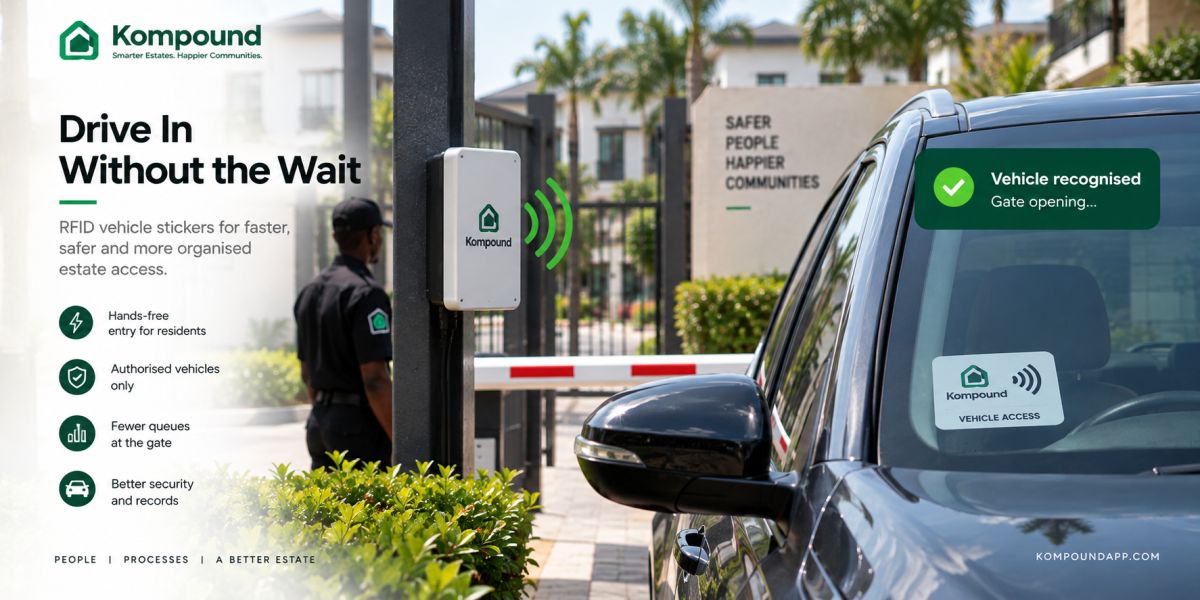
An RFID vehicle sticker lets your estate identify an authorised resident's car automatically as it approaches the entrance.
The reader detects the sticker.
Your access-control system checks whether that vehicle is still authorised.
If everything is valid, the gate or boom barrier can open.
The resident does not need to lower the window, tap a card or call security.
That can make a busy estate gate much faster.
But the sticker is only one part of the system.
You still need the correct reader, proper installation, access rules and a way to disable a vehicle when somebody moves out or sells their car.
What is an RFID vehicle sticker?
An RFID vehicle sticker is a small electronic tag usually attached to the inside of a vehicle's windscreen.
It contains an RFID chip and antenna.
When the vehicle approaches a compatible reader, the reader detects the tag's unique identifier.
Your access-control system then checks whether that identifier belongs to an authorised vehicle.
If access is allowed, the controller can trigger:
- Boom barrier
- Sliding gate
- Swing gate
- Another compatible access point
The sticker itself does not physically open the gate.
It identifies the vehicle.
Your access-control system makes the decision.
Why use a sticker instead of a normal access card?
A normal RFID card works well when somebody can hold it close to a reader.
That is less convenient for vehicles.
With a long-range windshield tag, the reader can identify the vehicle while it is still approaching the gate.
Depending on the hardware, read ranges can be several metres.
Commercial UHF windshield tags commonly use the 860–960 MHz UHF band and the EPC Gen2 / ISO 18000-6C standard. Some products advertise reading distances around 9–15 metres when paired with compatible readers.
That makes them useful for hands-free residential vehicle access.
What happens when your car approaches the gate?
A typical process looks like this:
Vehicle approaches → long-range reader detects RFID sticker → controller checks vehicle status → authorised vehicle is accepted → boom barrier or gate opens → access event is recorded.
The whole process can happen without the resident touching anything.
That is the main benefit.
At a busy estate gate, removing even a few seconds from each resident entry can significantly reduce queues.
UHF RFID is usually the technology you are looking for
You will see many products described simply as RFID.
That is too broad.
For long-range vehicle access, you will usually be looking at UHF RFID rather than the short-range cards commonly used at office doors.
Typical vehicle tags operate around:
860–960 MHz
and follow standards such as:
EPC Class 1 Gen 2 / ISO 18000-6C.
These systems are designed for longer reading distances and automatic vehicle identification.
Before buying tags, make sure they are compatible with your reader.
Do not assume every RFID sticker works with every access-control system.
How far away can the reader detect the sticker?
There is no single fixed distance.
The result depends on:
- Reader model
- Reader power
- Antenna
- Tag design
- Windshield
- Vehicle position
- Installation angle
- Radio environment
One ZKTeco long-range UHF reader currently sold by a Nigerian access-control supplier advertises an adjustable read range of up to 12 metres.
Other commercial windshield tags advertise ranges around:
- 6 metres
- 9 metres
- 10 metres
- 15 metres
depending on the reader and installation.
Do not choose the longest advertised distance simply because it sounds better.
Your reader should identify the correct vehicle in the correct lane.
A reader that detects tags from neighbouring lanes or vehicles outside the gate can create problems.
Reader placement matters more than people expect
Long-range RFID works best when the reader is positioned correctly.
Your installer should consider:
- Lane width
- Vehicle approach
- Antenna direction
- Gate position
- Boom barrier position
- Distance from reader to vehicle
- Height
- Nearby lanes
- Walls and metal structures
The objective is not maximum possible range.
The objective is a controlled reading zone.
You want the reader to detect the car approaching your entrance.
You do not want it unnecessarily reading cars on another road.
Where should the RFID sticker be placed?
Most windshield tags are designed to be attached to the inside of the windscreen.
The exact position should follow the tag and reader manufacturer's guidance.
Before installation:
- Clean the glass
- Dry it properly
- Avoid metallic coatings where possible
- Avoid heated windscreen wires
- Test the position
- Apply the tag firmly
Windshield composition and tint can affect RFID performance, which is why real installation testing matters.
Do not distribute 300 stickers before testing several different vehicle types at your actual gate.
Metallic tint can cause problems
Some windscreens and aftermarket tints contain metallic material.
Metal can interfere with UHF radio signals.
That can reduce range or prevent reliable reading.
Before rolling out tags estate-wide, test:
- Clear windscreen
- Factory tint
- Aftermarket tint
- Different vehicle brands
- SUVs
- Sedans
- Buses where applicable
If certain vehicles have problems, your installer may need to adjust placement, reader power or tag type.
Use tamper-evident stickers where possible
This is one of the most important security features.
A resident should not be able to remove the sticker from one authorised vehicle and casually transfer it to another vehicle.
Many vehicle-access RFID tags are designed to tear, damage the antenna or otherwise show evidence of tampering when removed.
Several commercial windshield-tag systems specifically describe their labels as tamper-evident or non-transferable.
That gives you a much stronger relationship between:
tag → vehicle → resident.
If your tag can be peeled off and moved repeatedly, you lose much of that advantage.
Do not treat the tag number as the vehicle
The RFID identifier should be connected to a proper vehicle record.
Your management system may store:
- Resident
- Vehicle
- Registration number
- RFID tag ID
- Property
- Status
- Date issued
- Expiry where applicable
Then if the resident sells the car, you can disable the old tag.
If the resident moves out, you remove access.
If the tag is damaged, you issue another one.
Your gate access should be controlled by the database.
Not by the fact that somebody possesses a sticker.
What happens when a resident sells the car?
Disable the tag.
Do not leave the old credential active simply because it has already been issued.
Your process should be:
- Resident informs management.
- Old vehicle is removed or marked inactive.
- Old RFID credential is disabled.
- New vehicle is registered.
- New tag is issued.
That prevents a car that no longer belongs to your resident from continuing to enter automatically.
What happens when someone moves out?
The same principle applies.
Their vehicle access should end when their authorisation ends.
A digital access system should let management disable a vehicle immediately.
You should not depend on your gateman remembering that a particular Toyota no longer belongs in the estate.
Can RFID stickers be copied?
You should assume no credential is automatically secure just because it uses RFID.
RFID security depends on:
- Tag type
- Protocol
- Reader
- Controller
- Backend configuration
- Whether unique identifiers are validated properly
For an ordinary residential estate, the more practical risk is often poor access administration rather than sophisticated radio attacks.
For example:
- Old tags remain active.
- Staff issue tags without proper records.
- Residents share transferable credentials.
- Reader ranges are badly configured.
You reduce those risks by using unique tags, tamper-evident installation and a properly maintained access database.
For higher-security environments, ask the vendor what anti-cloning or authentication protections the proposed system actually provides.
Should the sticker open the gate automatically?
Usually, that is the point for resident vehicles.
But you can decide how much automation your estate wants.
Fully automatic
Authorised tag detected.
Gate opens automatically.
Security-confirmed
Tag is detected.
Security sees the vehicle record and approves the opening.
Hybrid
Known resident vehicles open automatically while unusual events require guard intervention.
The right choice depends on your estate's traffic and security policy.
What happens if the sticker cannot be read?
You still need a fallback.
Your gateman may verify the resident using:
- Resident app
- Vehicle record
- Access card
- Other approved credential
- Management confirmation
The security officer should not be forced to choose between blocking a genuine resident indefinitely and opening the gate without any verification.
Document the fallback procedure.
What about multiple cars in one household?
Your system should support one credential per authorised vehicle.
For example:
House 12 may have:
- Toyota Camry
- Lexus RX
- Honda Accord
Each vehicle should have its own tag and unique record.
Do not issue one removable tag for the household to pass between cars.
That defeats the purpose of vehicle identification.
What about tenants?
Treat the vehicle based on its authorisation, not simply property ownership.
A registered tenant may have authorised vehicles.
When the tenancy ends, management should deactivate those credentials.
The exact rules should match your estate's access policy.
What about visitors?
Visitors usually should not receive permanent RFID windshield stickers.
A resident vehicle and a visitor are different access types.
For visitors, temporary options are usually more appropriate:
- Visitor code
- QR pass
- Security approval
- Temporary digital credential
That gives you a cleaner distinction.
RFID sticker for recurring authorised resident vehicle.
Temporary pass for temporary visitor.
RFID vs number-plate recognition
Both can support hands-free vehicle access.
RFID
Your vehicle carries a physical credential.
The reader identifies the tag.
Number-plate recognition
A camera reads the vehicle registration plate.
You do not necessarily need a physical sticker.
RFID can be extremely reliable when the vehicle has the correct tag and the reader installation is good.
ANPR avoids issuing physical tags but depends more heavily on camera position, plate visibility, lighting and image processing.
Some estates may eventually combine both.
RFID vs remote control
A remote control opens your gate.
An RFID system identifies the vehicle.
That is an important difference.
With shared remotes, you may not know:
- Which car used the remote
- Who currently possesses it
- Whether someone copied or borrowed it
With properly managed RFID, each vehicle can have its own credential.
That gives you better accountability.
RFID vs access cards
Cards work well for pedestrians and short-range access.
For vehicle lanes, long-range UHF tags are usually more convenient because the resident does not need to stop and reach out of the window.
Your estate may therefore use:
- RFID windshield stickers for resident vehicles
- Cards or fobs for pedestrian access
- Temporary passes for visitors
Different users can have different credentials.
What does an RFID vehicle system cost in Nigeria?
The cost has two main parts:
Reader infrastructure
and
individual vehicle tags.
The reader is usually the larger upfront expense.
One Nigerian supplier currently lists a ZKTeco long-distance UHF reader at $289.97, with an adjustable read range up to 12 metres and IP66 weather protection.
You may also need:
- Access controller
- Boom barrier or gate motor
- Power supply
- Backup power
- Cabling
- Mounting
- Network connection
- Installation
- Configuration
RFID windshield stickers themselves are usually comparatively inexpensive per vehicle, especially when purchased in quantity, but many commercial suppliers quote them based on volume, printing and encoding rather than publishing a fixed unit price.
Get a complete quotation based on your number of gates and vehicles.
Custom printing can help administration
Your estate can use plain RFID tags.
But customised tags may make administration easier.
You can include:
- Estate logo
- Serial number
- Vehicle sticker number
- QR code
- Barcode
- Other visible identifier
Commercial RFID suppliers commonly offer printing and encoding as part of windshield-tag production.
Do not print sensitive resident information openly on the sticker.
A serial number is usually enough for visible identification.
Your reader needs reliable power
If the gate reader has no power, your stickers cannot be detected.
Plan power for:
- Reader
- Access controller
- Gate motor
- Boom barrier
- Network equipment
For Nigerian estates, that may mean:
- UPS
- Inverter
- Battery
- Generator
- Solar
The reader should be included when you calculate your gate backup-power requirements.
What happens when the internet is down?
This depends on how your access controller is designed.
For a strong estate setup, basic resident vehicle access should not necessarily depend on a live cloud connection for every entry.
The local controller can maintain an authorised credential list and make the access decision locally.
Records can then synchronise when connectivity returns.
Ask your vendor exactly what happens during an outage.
Do not assume RFID automatically means offline access.
Maintenance is fairly simple, but still necessary
RFID systems have fewer moving parts than your physical gate hardware.
You should still inspect:
- Reader mounting
- Reader enclosure
- Cabling
- Power supply
- Network
- Controller
- Tag performance
- Access records
Your biggest ongoing administrative task will usually be maintaining the authorised vehicle list.
Technology cannot tell you that a resident moved away if nobody updates the record.
Common mistakes to avoid
Buying short-range tags for a long-range gate
Make sure the reader and tag technology match the use case.
Installing stickers wherever residents want
Placement affects performance.
Using transferable tags
Choose tamper-evident tags where possible.
Leaving former residents active
Remove access when authorisation ends.
Turning the reader power too high
Longer range is not automatically better.
Control the reading zone.
Issuing tags without vehicle records
Every tag should belong to an identifiable vehicle.
Using RFID for visitors
Permanent credentials should generally be reserved for recurring authorised access.
Forgetting backup power
Your reader needs electricity too.
Automating a badly designed lane
Fix your traffic and gate process before adding hardware.
How RFID vehicle access can work with Kompound
Kompound manages the resident, visitor and gate-access side of your estate.
RFID can add a faster physical identification method for authorised resident vehicles.
That means your estate can separate two common gate journeys.
For a resident vehicle:
Registered vehicle → RFID detected → access checked → compatible gate opens.
For a visitor:
Resident creates visitor pass → visitor arrives → security verifies temporary access → entry is recorded.
This distinction keeps resident access fast without turning visitor access into a permanent-credential system.
Depending on the hardware selected for your estate, RFID readers can form part of a wider gate setup alongside:
- Boom barriers
- Gate controllers
- Visitor codes
- QR access
- Security verification
- Backup power
The objective is not to put a sticker on every car.
It is to remove unnecessary friction for vehicles your estate already trusts while retaining control over who remains authorised.
Want residents to enter without stopping at the gate?
If your estate has queues because your gatemen repeatedly verify the same resident vehicles, long-range RFID may be worth considering.
Before buying tags or readers, look at your gate layout, number of registered vehicles, entry lanes and existing gate equipment.
We can show you how Kompound handles your resident and visitor access workflows and where compatible vehicle automation can fit.
Frequently asked questions
What is an RFID vehicle sticker?
It is an electronic identification tag attached to a vehicle, usually on the inside of the windscreen, that can be detected by a compatible RFID reader.
What type of RFID is used for estate vehicle access?
Long-range vehicle systems commonly use passive UHF RFID operating around 860–960 MHz and standards such as EPC Gen2 / ISO 18000-6C.
How far can an RFID reader detect a vehicle?
Depending on the reader, tag and installation, commercial systems may work across several metres. Some products advertise ranges of roughly 9–15 metres.
Does the RFID sticker need a battery?
Passive UHF windshield tags do not normally need their own battery. They are powered by energy from the reader's radio signal.
Can a resident move the sticker to another car?
Tamper-evident windshield stickers are designed to make transfer difficult because removal damages or destroys the tag.
Can an RFID sticker open a boom barrier?
Yes, when the reader and access controller are properly integrated with the barrier.
Can RFID vehicle access work without internet?
It can where the local access controller stores and verifies authorised credentials locally. Ask the installer how the proposed system behaves when connectivity fails.
Do visitors need RFID stickers?
Usually not.
Temporary visitor codes or passes are generally more appropriate for people who do not require permanent vehicle access.
Can tinted windscreens affect RFID?
Yes.
Metallic tint and some windshield materials can reduce UHF performance, so tag placement should be tested on the actual vehicles.
Should you use RFID or number-plate recognition?
RFID provides a dedicated physical vehicle credential.
ANPR identifies the registration plate using cameras.
The better option depends on your gate, traffic, security requirements and budget.
The simple decision
RFID stickers work well when your estate wants fast, hands-free access for vehicles that enter repeatedly.
The sticker identifies the car.
The access controller decides whether it is still authorised.
The gate hardware handles the physical opening.
Get those three parts right, and your resident should be able to approach the gate and enter without unnecessary stopping, calls or manual verification.